The Last War of the Descending Age
AI forced the temple question. Finance broke the rat race. Food and language are reconnecting what radicalization severed. The cycle is producing what war could never produce.
The 2026 Iran-Israel-US war is widely read as a strategic outcome between parties. The framework reads it differently — as the closing manifestation of a configuration of conflict the cycle phase no longer sustains. The energy that produced this specific architecture of externalized civilizational warfare is structurally drying up. What surfaces underneath, when the architecture has dissolved sufficiently, is the substrate that radicalization severed and that the cycle is now structurally reconnecting.
The headlines announce the outcome
The Iran-Israel-US war that erupted on February 28, 2026 is widely read as a strategic victory for one side and a strategic defeat for the other. The 1979 architecture is dismantled. The Strait of Hormuz blockade is broken. The Velayat-e-Faqih institutional template — Khomeini's framework for clerical rule — is structurally decapitated by the joint US-Israeli airstrikes (codenamed Operation Epic Fury on the American side, Operation Roaring Lion on the Israeli side) that killed Supreme Leader Ali Khamenei in his compound on the war's opening day. The ceasefire mediated by Pakistan on April 8, 2026, led by Prime Minister Shehbaz Sharif and Field Marshal Asim Munir with Trump publicly crediting Pakistan as the broker, is described as the closing of one chapter in Middle Eastern security architecture and the opening of another.
The headlines are not wrong at their altitude. The strategic reorganization they describe is real. The dismantling of Iranian regional projection capacity is documented. The Saudi-Israel normalization preparation visible across early 2026 is real. The Gulf state integration with Israel is operational. The Pakistani terminal economic crisis is structurally underway. The American post-hegemonic withdrawal is empirically observable across munitions stocks, debt service ratios, and the Pacific posture that cannot be sustained alongside Middle East commitments.
What the headlines cannot read is what is happening underneath the headlines.
The framework reads this war structurally. Not as the strategic victory of one party. Not as the strategic defeat of another. As the closing manifestation of a configuration of conflict that the cycle phase no longer sustains. The energy that produced this specific architecture of externalized civilizational warfare — the 1979 Iranian Revolution as descending-phase orthodox-political imposition, the regional proxy networks as descending-phase coercive instruments, the dollar-secured oil-secured American security guarantor framework as descending-phase hegemonic substrate — is structurally drying up. What is dissolving is not one party's position relative to another. What is dissolving is the architecture all parties built across the descending-Kali period that ended in 1698 CE and whose institutional residue has continued operating on borrowed cycle energy ever since.
This was the last war of the descending age. Not because conflict ends humanly. Because the energy that produced this kind of conflict — externalized, civilizational, sustained through orthodox-political imposition, resolved through military coercion at scale — is no longer available. The cycle has changed. Ascending Dwapara is producing different conditions. What surfaces underneath, when the descending-phase architecture has dissolved sufficiently, is the substrate that radicalization severed and that the cycle is now structurally reconnecting.
This page reads what the cycle is producing through the war. Four converging pressure layers — AI forcing the L4–L5 question, finance and employment breaking simultaneously, food and dollar and energy collapsing as the descending-phase trinity, linguistic substrate reconnecting across the Bridge organs — all surface the same recognition. The recognition cannot be predicted. It can only be read. The cycle does not require anyone's agreement. Resistance is more pain.
The board as conventional analysis sees it
Conventional geopolitical analysis describes the chess board with appropriate detail.
The United States entered the war from a position of structural exhaustion. Federal debt approaching $39 trillion. Annual deficit running near $1.9 trillion (reported figures, US Treasury / Congressional Budget Office). Interest payments on the debt now exceed defense spending — a violation of Niall Ferguson's empirical observation that great powers historically lose hegemonic standing when debt service exceeds military expenditure. Munitions depletion across the seven-week active war phase was severe — open-source analyst tracking and CSIS/ACLED reporting indicate substantial multi-category inventory consumption, with replenishment lead times of one to four years. The American security guarantor framework that has structured global commerce since 1944 cannot be sustained through repeated engagements at this intensity. The Pacific posture against Chinese expansion now rests on stockpiles that Middle East operations have measurably depleted.
China entered the war from a position of internal consolidation pressure. Real estate sector unwinding. Demographic decline accelerating. Local government debt at industry-estimated levels exceeding $13 trillion in off-balance-sheet liabilities. Youth unemployment so severe that the official metric was suspended in 2023. Military leadership purges across rocket force commanders, defense ministers, foreign ministers — approximately twenty senior officials removed in two years. The Chinese strategic posture during the war was managed neutrality with limited mediation function. China brokered the original Saudi-Iran rapprochement of 2023 and contributed to the April 2026 ceasefire architecture, but China did not commit forces, did not extend significant material aid to Iran, and did not align against the United States in the war's resolution. The temple turn at population scale across China — temple visits by young Chinese rising significantly across 2024–2026, the Confucian-Daoist-Buddhist substrate visibly reasserting beneath Marxist-Leninist surface — is evidence that the cycle's pressure on China is operating from inside the population rather than through external state action.
Russia entered the war from Rahu Mahadasha distributed engagement. The Ukraine war continues into its fourth year. The strategic patience pattern that Saturn-in-6H produces — capacity to absorb costs that break other civilizations, willingness to fight long attritional wars across years rather than months — has been demonstrated empirically. Russia provided intelligence support to Iran without committing forces. Russia did not defend Iranian assets. Russia let Iran be decapitated by Israel-US strikes while maintaining the appearance of supporting Iran. The strategic logic was Rahu — gain through partner's chaos rather than partner's strength. A weakened Iran more dependent on Russia is more useful to Russia than a strong Iran that does not need Russian patronage. Russia's tie-breaker function — keeping multipolar space open by simply existing as independent civilizational pole — preserves the geometry that allows every other civilization to remain itself rather than choose between American and Chinese spheres.
Iran entered the war from regime crisis already underway. The protests that erupted in late December 2025 produced what is now widely characterized as the deadliest period of repression in modern Iranian history. Death tolls vary widely by source — from the Iranian government's count of 3,117, to HRANA's confirmed 7,015 with thousands more under review, to Iran International's claim of more than 36,500 citing classified IRGC documents. Amnesty International characterized the January 8–9, 2026 massacres as the largest in modern Iranian history. The leadership was visibly weakened before the strikes began. The economy had collapsed by every metric — inflation in the 40–60% range, currency collapse exceeding 90% since 2018, oil revenues constrained by sanctions, regional projection capacity exhausted by years of conflict in Yemen, Lebanon, Iraq, and Syria. Khamenei's death on February 28, 2026 was not the cause of the regime crisis; it was the most visible single moment of the regime crisis that had been structurally underway for several years. The 47-year orthodox-political experiment was structurally failing before any external strike landed.
Israel entered the war from the most successful strategic position in its history. The 1979-reversal campaign across October 2023 to February 2026 had progressively dismantled the architecture of Iranian-led resistance — Hamas substantially destroyed, Hezbollah decapitated, the Assad regime collapsed, Houthi capabilities reduced, Iranian air defenses systematically degraded across the Twelve-Day War of June 13–24, 2025 (Operation Rising Lion, Oman-mediated ceasefire) and Operation Epic Fury / Operation Roaring Lion of February–April 2026. The strategic environment Israel had inhabited for 47 years was being reorganized in Israel's favor across multiple simultaneous theatres. The diplomatic baton passed from Oman (Twelve-Day War mediator) to Pakistan (2026 ceasefire mediator) — partly because Oman lost credibility when the February 27 "breakthrough" was followed by the joint US-Israeli strikes the next day.
Saudi Arabia entered the war from active substrate recovery. The de-Wahhabization campaign Mohammed bin Salman has conducted since 2017 — religious police defanged, senior Wahhabi clerics imprisoned, religious endowments restructured under state control, Wahhabi educational curriculum reformed, the global Wahhabi religious export campaign reversed — represents Arab civilization recovering its actual heritage after a 273-year detour from the 1744 Wahhab-Saud pact. The Vision 2030 economic transformation is the surface of this. The pre-Wahhabi Hejaz cosmopolitanism, the Nabataean Arabian heritage developed at AlUla, the Diriyah project recovering the First Saudi State of 1727–1818 — these are substrate work happening in parallel.
Pakistan entered the war from terminal orthodox-political crisis. Foreign reserves of approximately $21.7 billion against external financing requirements of $19.4 billion. Energy import dependency at 81% against an oil import bill that doubled during the war. Fertilizer factories shut. Indus Waters Treaty suspended by India. Cricket isolation continuing. The Two-Nation Theory founding premise — that Hindus and Muslims constitute separate nations requiring territorial separation — has been empirically refuted by Indian Muslims thriving inside India while Pakistan progressively fails. The orthodox-political establishment that has governed Pakistan for 78 years has lost its civilizational substrate to sustain itself. (That the Pakistani state nonetheless mediated the April 8 ceasefire is part of the same structural pattern — orthodox-political surfaces dissolving while the underlying civilizational substrate, here visible in Asim Munir's strategic patience and Sharif's diplomatic skill, becomes operationally accessible.)
India entered the war from the strongest civilizational-strategic position in its modern history. World's most populous country at approximately 1.42 billion. Fastest-growing major economy. Largest rice exporter shipping to 172 countries. Roughly 60% of global vaccine production. Continuing food and pharmaceutical exports to the entire Middle East throughout the war. Chabahar Port operational. INSTC corridor developing. Naval presence across the Indian Ocean securing trade lanes that no other power could secure during the regional crisis. Multi-aligned posture refusing to join either the US-Israel coalition or the Iran-Russia-China grouping. India fed the region while feeding itself, healed the region while being its own pharmacy, secured the region's seas while not being combatant in the war.
This is the chess board as conventional analysis describes it. The description is accurate at its altitude.
What conventional analysis cannot read is the cycle phase the chess board is operating in.
The cycle pivot
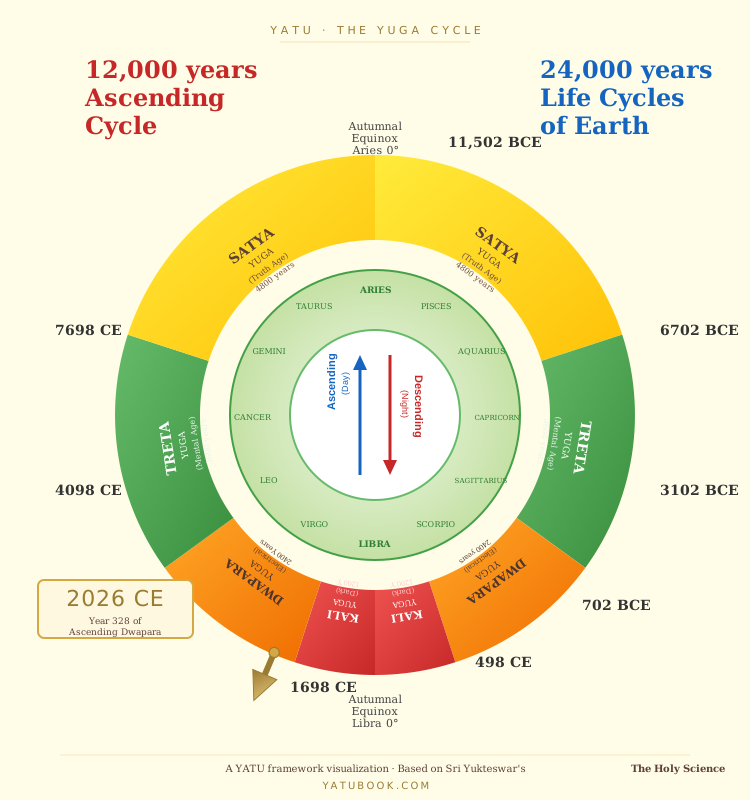
We are in ascending Dwapara.
The Yuga calendar tradition preserved in India describes a long cycle of consciousness — descending from the highest age (Satya) through Treta and Dwapara into the lowest age (Kali), reaching the deepest descent, and then ascending back through the same phases in reverse. The cycle is not metaphorical. It is structural. It operates on the same logic that governs the precession of the equinoxes, the long planetary cycles, and the cosmic conditions that determine what consciousness can access at what phase of the revolution.
Sri Yukteswar's restoration of the Yuga calendar in The Holy Science (1894) corrected centuries of mistaken interpretation that had inflated the cycle's duration to incomprehensible scales. The actual cycle is approximately 24,000 years total — 12,000 years descending, 12,000 years ascending. The deepest point of descending Kali fell around 500 BCE. The cycle has been ascending since then. The transition from ascending Kali into ascending Dwapara occurred in 1698 CE.
Year 2026 of the Common Era is year 328 of ascending Dwapara.
This matters because the cycle phase determines what energy is available, what structures can sustain themselves, what dissolves automatically when the cycle pressure shifts. In descending phases, the cycle pushes consciousness outward — empires expand, conflicts externalize, religions institutionalize, worth accumulates externally, identity organizes around tribe and territory and ideology. In ascending phases, the cycle pushes consciousness inward — nervous systems integrate, conflicts migrate to interior, religions recover their mystical layer, worth becomes consciousness itself, identity organizes around recognition.
The same energy. Different direction. The cycle phase determines which direction is operationally available.
David Frawley's analysis of Sri Yukteswar's calendar identifies a sub-cycle structure where each major phase contains four sub-phases mirroring the larger cycle. The current period, by Frawley's reading, is the Kali sub-phase of ascending Dwapara — running approximately 1900 to 2100 CE. This is the darkest hour before dawn — the residual descending-phase energy still operating within the larger ascending phase. The descending-Kali templates that built the modern world order — Westphalian state system from 1648, post-1815 Concert of Europe, post-1918 League of Nations, post-1945 American hegemony, the dollar-secured oil-secured global commerce architecture — are descending-phase structures continuing on borrowed energy through the ascending-Dwapara Kali sub-phase.
The borrowed energy is running out.
What ascending Dwapara is producing structurally is the inward turn at every scale. Civilizations recovering substrate beneath orthodox-political imposition. Nations recovering civilizational identity beneath ideological imposition. Households recovering meaning beneath consumer L1–L3 saturation. Individual nervous systems recovering recognition beneath fragmented attention. The same structural movement at multiple scales simultaneously.
The 2026 Iran-Israel-US war is one surface manifestation of this larger structural transition. The war's particular configuration belongs to the descending-phase architecture that is exhausting. The dissolution of the Velayat-e-Faqih is descending-phase orthodox-political imposition exhausting. The dismantling of Iranian regional projection capacity is descending-phase coercive-instrument framework exhausting. The reorganization of Middle Eastern security architecture toward integration with substrate-recovering Sunni Arab world is descending-phase American security guarantor framework exhausting. The emergence of multipolar economic architecture is descending-phase dollar hegemony exhausting.
None of these dissolutions occur because anyone is winning. They occur because the cycle phase no longer sustains them. The energy is moving inward. The architecture that descending energy built cannot be sustained by ascending energy. What is sustainable in ascending Dwapara is the inward turn — the substrate recovery, the contemplative-tradition reactivation, the civilizational dialogue across surviving Bridges, the L4–L5 work that the human nervous system was always specified for.
AI is the cycle's mechanism for this transition.
This is the framework's most compressed claim. AI did not come to take human jobs. AI came to dissolve the L1–L3 ladder that descending-phase economy built and that humanity was never specified to climb. AI does L1–L3 cognition increasingly well. What remains uniquely human is L4–L5 recognition — the contemplative awareness that recognizes its own operating state, the cosmic-relational integration that situates consciousness within the larger field. AI cannot reach L4–L5 by category. The cycle is producing AI at exactly the moment when L4–L5 work becomes operationally unavoidable. The forced redirection from outer worth-building to inner recognition is happening structurally, whether anyone consciously chooses it or not.
The four converging pressures the rest of this page reads — AI forcing the L4–L5 question, finance and employment breaking simultaneously, food-dollar-energy collapsing as descending-phase trinity, linguistic substrate reconnecting across Bridge organs — all surface the same structural recognition. The cycle is producing the inward turn at civilizational scale. The 2026 war is one of the descending-phase architecture's last visible manifestations before the configuration that produced it can no longer sustain itself.
3a. AI forces the L4–L5 question. Temple reestablishes from substrate.
The L1–L5 architecture maps consciousness operations across distinct domains.
L1 is material substrate — body, biology, physical matter. AI dissolves the L1 cognitive overlay (medical diagnosis, biological analysis, scientific computation) but cannot replace embodied presence. L2 is energetic substrate — vital energy, breath, embodied feeling. AI cannot reach L2 because L2 requires biological substrate. L3 is cognitive operation — analysis, synthesis, problem-solving, communication, planning. AI dominates L3. This is the layer being structurally commoditized. L4 is recognitional consciousness — direct awareness of consciousness recognizing its own operating state. AI cannot reach L4 because L4 is not cognition; it is recognition. L5 is cosmic-relational integration — consciousness recognizing its participation in the larger field. AI cannot reach L5 by category.
The descending-phase economy organized human worth around L1–L3. The professional class extracted income from L3 cognition. The skilled trades extracted income from L1 manual labor combined with L3 problem-solving. The service economy extracted income from L1 embodiment combined with L3 social cognition. The entire worth-building architecture of modern economy was L1–L3 organized.
AI's structural effect is not gradual displacement but categorical dissolution of the L3 layer humans had monopolized. What remains human at L1–L2 (embodied presence, biological vitality) and L4–L5 (recognition, cosmic-relational integration) cannot be substituted by AI. What was uniquely human at L3 — cognition, analysis, synthesis — is being commoditized at speeds that exceed any institutional adaptation timeline.
The question this forces is not economic. It is identity-level.
If a human's worth has been organized around L1–L3 contribution, and L3 is commoditized, what remains? The framework's reading is that what remains is what was always uniquely human — the L4–L5 recognition that contemplative traditions across cultures have been mapping for millennia. The Vedantic atman-Brahman recognition. The Sufi fana-baqa sequence. The Christian-mystic unio mystica. The Buddhist nirvana. The Kabbalistic devekut. The Zoroastrian vohu manah. The Daoist wu wei. The Indigenous contemplative traditions globally. Every major contemplative lineage has preserved the same structural recognition that AI is now forcing humanity to recover at population scale.
The cycle is doing this by producing AI at exactly the moment when the L1–L3 ladder dissolves. Not coincidence. Structural design.
This requires temple. Not as institutional religion. As mandir.
The Latin etymology of temple is templum — a cut-off boundary, a designated zone separated from ordinary space. Descending-phase logic. The Sanskrit etymology of mandir is dwelling, abiding place, where consciousness rests in itself. Ascending-phase logic. The body-as-temple teaching that appears across traditions only operates correctly from the mandir etymology. The body is not a templum set apart from ordinary life. The body is a mandir — the dwelling place where consciousness recognizes its own operating state.
Temple in this sense is being structurally reestablished across civilizations.
In China, temple visits by young Chinese have risen significantly since 2023, with Confucian-Daoist-Buddhist substrate visibly reasserting beneath Marxist-Leninist surface. The Lama Temple in Beijing now requires hours-long waits among visitors in their twenties. The framework reads this as the cycle producing inward turn at population scale before institutions know how to teach it.
In India, the consecration of Ram Mandir at Ayodhya in January 2024 was structurally not a political event but a civilizational event — the substrate the descending-Kali period had buried reasserting institutional form. The framework reads this through equal-honor discipline: every civilization recovers its substrate temple. India recovers Ram Mandir. Iran recovers Sufi shrines (Hafez tomb, Lal Shahbaz Qalandar shrine in Sehwan, Sufi sama gatherings publicly returning). Saudi Arabia recovers pre-Wahhabi Hejaz cosmopolitanism (AlUla, Diriyah). Russia recovers Russian Orthodox Christianity (1,037-year continuous lineage reasserting after 70-year Soviet imposition). Indigenous peoples globally recover ceremony traditions long suppressed.
Temple as mandir is what L4–L5 work requires. Not institutional religion. The dwelling place where the contemplative substrate the cycle preserved across descending phases becomes operationally accessible again.
AI forces this question. The cycle produces the conditions. The substrate the Bridge organs preserved is what the question's answer requires.
3b. Finance and employment break simultaneously
The financial architecture of the descending-phase global order has reached structural exhaustion across multiple layers simultaneously.
The United States carries roughly $39 trillion in federal debt. The annual deficit runs at approximately $1.9 trillion. Interest payments on the debt now exceed defense spending — the empirical condition Niall Ferguson identified as preceding hegemonic transition across centuries of comparative historical data. The debt-to-GDP ratio at 100% projects to substantially higher levels by mid-century under current trajectories. No major democracy has reduced debt at this scale through political process within a single human lifetime.
The dollar's hegemonic position depends on continued global willingness to hold dollar reserves and conduct trade in dollars. That willingness is structurally eroding. Russia conducts energy trade in yuan, ruble, rupee, and gold. India purchases Russian oil discounted from sanctions and refines it for global re-export. The BRICS+ alliance now includes major oil producers (Saudi Arabia, UAE, Iran) whose energy trade increasingly bypasses dollar settlement. The mBridge central bank digital currency cooperation among China, Hong Kong, Thailand, UAE, and Saudi Arabia provides operational alternative to dollar-cleared correspondent banking. Gold accumulation by central banks has accelerated to levels not seen since the Bretton Woods era.
The financial architecture is not collapsing in a single moment. It is structurally eroding across many simultaneous pressure points. The cycle phase no longer sustains the dollar-secured, oil-secured, American-guaranteed global commerce framework that has structured world trade since 1944.
Underneath the financial layer, employment is breaking simultaneously across multiple regions.
In India, AI displacement has hit the IT sector that constituted the country's primary middle-class employment generator. Tata Consultancy Services, Infosys, Wipro, and other major IT services firms are reducing fresher hiring at unprecedented rates. The traditional Indian IT services model — providing L3 cognitive labor at lower cost than Western alternatives — was descending-phase economy's most successful Indian adaptation. AI dissolves it from underneath.
In China, youth unemployment reached levels so severe that the Chinese government suspended publishing the metric in 2023. The real estate sector that absorbed approximately 30% of Chinese GDP is unwinding through cumulative defaults. The manufacturing employment base is being progressively automated. The descending-phase economic model — manufacturing for export to dollar markets — is structurally failing at exactly the moment the population would need it most.
In the Middle East, oil-dependent employment is structurally exposed to post-oil transition. Iran's economy under sanctions cannot generate employment for its young population. Pakistan's industrial base cannot absorb new entrants to the labor force. The Gulf states' Vision 2030-style transformations are deliberate transitions away from oil-dependent employment toward service and tourism economies that the population is not yet trained to fill.
In Europe, structural stagnation has meant flat real wages for two decades while the labor force ages and shrinks. The continent that built modernity's middle class can no longer sustain middle-class formation at population scale.
In the United States, the labor force participation rate of prime-age workers has not fully recovered to pre-2008 levels. The deaths-of-despair pattern documented by Anne Case and Angus Deaton — rising mortality among working-class Americans through suicide, opioid overdose, and alcoholism — is descending-phase economy's failure mode written in human bodies.
These are not separate national crises. They are surface manifestations of the same structural condition. The descending-phase economic model — externalized worth-building through L1–L3 employment, financialized through dollar-secured global commerce, institutionalized through corporate-bureaucratic structures, justified through consumption-as-meaning — has reached the end of its sustainable run. More of the same model cannot resolve the model's exhaustion.
What is structurally emerging as alternative is what the substrate-recovery framework names. Direct relationship economics where producers and consumers connect without platform extraction. Lineage transmission infrastructure where knowledge passes through teacher-student rather than institutional credentialing. Real-asset operations where physical substrate businesses provide stable foundation. Substantive integration consultancy where cross-coordinate synthesis serves organizations the descending-phase consultancies cannot address. Civilizational dialogue infrastructure where the Bridge organs reactivating provide intellectual production the institutional academy cannot replicate.
The cycle is producing this alternative not through anyone's design but because the descending-phase model is structurally exhausting and the ascending-phase substrate is structurally surfacing.
3c. Food, dollar, and energy converge on collapse. India structurally aligns the region.
The descending-phase global order rested on a trinity of integrated systems — the dollar as reserve currency, oil as energy substrate, and food as the fungible commodity that fed populations dependent on neither sovereign currency nor sovereign energy. The trinity was integrated. Each system depended on the other two functioning.
The 2026 war revealed all three under simultaneous stress.
Energy. The Strait of Hormuz blockade by Iran from March 4, 2026 demonstrated the fragility of the oil-secured shipping framework. Approximately 20% of global oil consumption transits Hormuz. The blockade required extensive American naval deployment to manage and produced sustained price elevation that affected every economy on the planet. The war's munitions consumption demonstrated that sustained warfare at this intensity cannot be maintained even by the strongest military power. The energy security architecture that descending-phase global order built across the post-1973 period reached its operational limits within seven weeks of sustained engagement.
Dollar. Sanctions weaponization against Iran tightened during the war while simultaneously demonstrating sanctions' diminishing returns. Iran maintained oil exports through alternative channels — China, India under refining and re-export arrangements, Russia. The BRICS+ payment systems matured operationally across the war. The dollar's percentage of global reserves continued the multi-decade decline that has accelerated since 2022. Central bank gold purchases reached unprecedented levels. The dollar did not collapse during the war. The dollar's monopoly on global commerce continued eroding through structural pressure that the war intensified rather than created.
Food. This is where the descending-phase trinity's collapse became most acutely visible to populations.
The Middle East food import dependency had been one of the descending-phase order's most stable features. Gulf states imported approximately 80% of caloric intake. Egypt imported approximately 50% of wheat consumption — historically the largest wheat importer on Earth. Jordan imported 95% of food. Iran's agricultural self-sufficiency, already compromised by sanctions, collapsed further as fertilizer imports failed and water stress intensified. Pakistan's fertilizer factories shut due to gas shortages. Bangladesh's fertilizer plants reduced production. The agricultural input chain that fed the region's populations was structurally broken.
The war disrupted approximately 70% of regional food import flows during peak crisis. Consumer prices spiked 40–120% across multiple food categories. The UN World Food Programme estimated 45 million additional people facing acute hunger as direct consequence of war-related supply chain disruption.
India alone had the structural capacity to feed the region during this crisis.
The world's largest rice exporter (approximately 40% of global exports, shipping to 172 countries). The world's second-largest wheat producer. Roughly 60% of global vaccine production. 60–70% of basmati exports going to the Gulf. The pharmaceutical capacity that produces affordable generics for global health. Continuing exports to Iran, Iraq, Egypt, Jordan, Saudi Arabia, UAE throughout the war despite domestic price pressure.
This was not a strategic choice India made during the war. This was India being India structurally — annapurna, the food source, the civilizational position India has held across millennia of regional engagement. The dharmic principle of annadan (gift of food) operating at civilizational scale during a crisis the descending-phase order could not manage.
The structural consequence is the alignment the cycle is producing.
When food, dollar, and energy break simultaneously, every civilization that depends on the descending-phase trinity faces existential pressure. India alone has the food capacity to address the crisis at the scale the region requires. Therefore the region structurally aligns with India. Not by Indian choice. Not by Indian coercion. By cycle production.
The Iran of substrate-recovery period needs Indian food during transition. The Saudi Arabia of Vision 2030 transformation needs Indian markets during post-oil pivot. The Gulf states need Indian labor, Indian remittances, Indian medical capacity, Indian food, Indian pharmaceuticals continuously. The Egypt of post-Brotherhood Sufi-public-revival period needs Indian agricultural cooperation. The Pakistan of terminal orthodox-political crisis depends, even in active hostility, on Indian humanitarian supply for population survival.
Every civilization in the central theatre that emerges from substrate recovery will have Indian civilizational presence woven into its survival memory of the transition period. This is annapurna at civilizational scale, operating across decades, building civilizational gratitude that descending-phase coercive-instrument relationships could never produce.
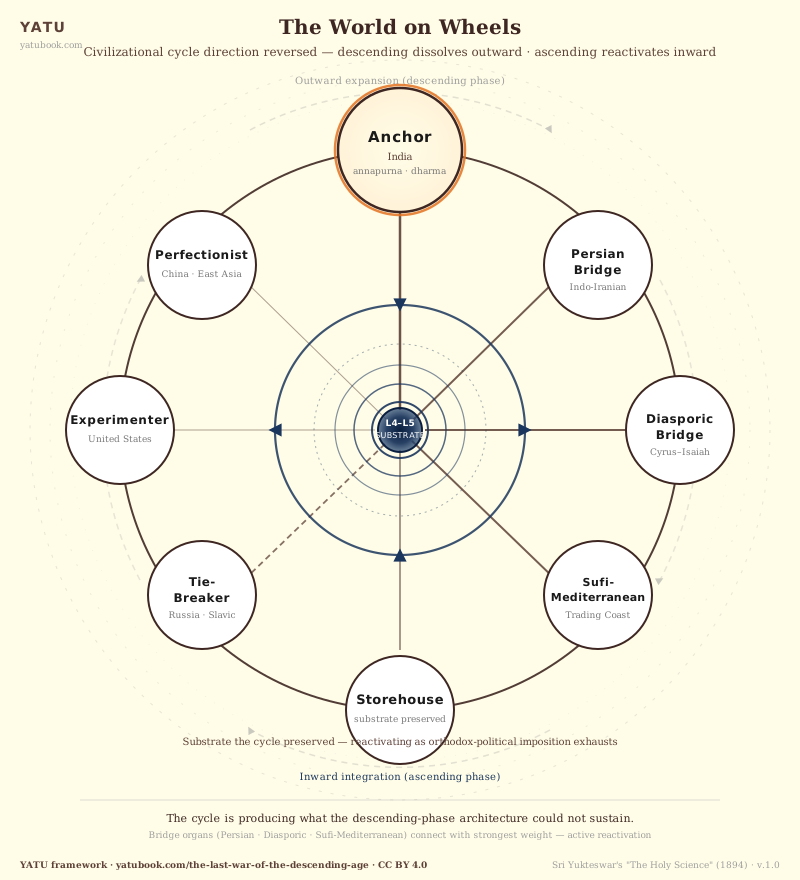
Russia's tie-breaker function preserves multipolar space. Israel's Sentinel function guards Diasporic Bridge civilizational continuity. The Sufi-Mediterranean continuity provides reference for substrate recovery across the Sunni Arab world. India's Anchor function provides the structural substrate — food, medicine, navy, civilizational dialogue, multi-alignment, strategic patience — that allows every other civilization's substrate recovery to proceed without collapsing into population-scale humanitarian catastrophe.
The cycle produces this alignment. India does not need to seek hegemony. The hegemony seeks India because the cycle's pressure on the descending-phase trinity makes Indian civilizational function structurally indispensable.
3d. Linguistic substrate reconnects. What radicalization separated, the cycle reunites.
The descending-Kali period imposed orthodox-political identity across civilizational substrate that was older, deeper, and more linguistically connected than the orthodox-political layer recognized. Radicalization severed connections that had operated for thousands of years.
The Indo-European language family connects Sanskrit, Persian, Greek, Latin, Slavic, and Germanic languages through a common root. The Indo-Iranian sub-family connects Sanskrit and Avestan (the language of Zoroastrian sacred texts) as sister languages. The Vedas and the Avesta share religious vocabulary, ritual structures, deity names that traveled different directions from a common source — Mitra appearing in both traditions, Indra appearing in both, the words for fire and water and sacrifice cognate across the two corpora.
This linguistic kinship is not abstract academic interest. It is operational substrate that the descending-Kali period buried beneath orthodox-political imposition.
When the Velayat-e-Faqih dissolves and Persian civilizational substrate reasserts in Iran, what surfaces is the linguistic-civilizational-philosophical kinship with Indian civilization that had been continuous for at least 4,000 years before the Arab conquest of 651 CE and that had continued in modified form through the Persian Islamic period until the 1979 imposition obscured it. The substrate is not gone. The substrate was preserved through the descending phase, the way Vedic texts were preserved through eleven different recitation patterns by different lineages — redundant parallel attestation that no single political pressure could erase.
The Mughal period in India operationalized the Indo-Persian civilizational synthesis at administrative and cultural scale. Persian was the literary language of Mughal courts. Persian poetry, architecture, miniature painting, philosophical traditions integrated with Indian forms. Akbar's Din-i-Ilahi attempted explicit synthesis. The Parsi community — Zoroastrians who migrated to India in the 8th–10th centuries CE preserving Persian religious tradition while integrating with Indian civilization — functions as living link of the Indo-Persian civilizational kinship that descending-phase impositions on both sides could not sever.
The Semitic language family connects Hebrew, Aramaic, Arabic, and Syriac. Hebrew and Arabic share more grammatical structure than English and German do. The Abrahamic substrate beneath Jewish, Christian, and Islamic religious traditions traces to a common civilizational source. Cyrus the Great's edict of 538 BCE freed Jews from Babylonian captivity, enabled rebuilding of the Second Temple, and was recorded in the Hebrew Bible at Isaiah 45:1 with the title moshiach (anointed one) — the only non-Jewish ruler given this title in the Hebrew canon. The Persian-Jewish civilizational gratitude is foundational and was operational across 2,500 years before the 1979 imposition obscured it temporarily.
The Andalusian period (711–1492 CE) operationalized Jewish-Muslim-Christian civilizational synthesis at scale. Maimonides wrote in Arabic. The translation of Indian and Greek texts into Arabic, then from Arabic into Latin, transmitted classical knowledge that European civilization had lost. The Sufi-Bhakti synthesis that flourished in medieval India connected Persian Sufi traditions with Hindu devotional traditions across Punjab, Sindh, Bengal, the Deccan — Bulleh Shah, Waris Shah, Baba Farid, Lal Shahbaz Qalandar, Shah Abdul Latif Bhittai operating in the same civilizational space as Kabir, Mirabai, Nanak, the Bhakti poets across regional traditions.
The radicalization period of the past three centuries — Wahhabi imposition from 1744, post-1979 orthodox-political projects across multiple Muslim-majority states, Hindu nationalist instrumentalization where it occurs, Christian nationalist instrumentalization where it occurs — separated what the linguistic-civilizational substrate had connected continuously for millennia. The separation was orthodox-political, not civilizational. The substrate continued underneath.
What the cycle is producing now is the reactivation of the linguistic substrate as the orthodox-political imposition exhausts. The reconnection is observable across multiple surfaces:
Iranian-Indian academic exchange resumes through Persian language scholarship. Indian universities reactivating Persian programs that the descending-Kali period had let lapse. Iranian intellectuals returning to Persian-Indian civilizational dialogue beneath orthodox-political surface. The Chabahar Port and INSTC corridor as physical infrastructure of Indo-Iranian linguistic-civilizational reactivation.
Sufi-Bhakti dialogue resumes across the Persianate world. Hafez recitation in Iranian homes despite four decades of regime suppression. Rumi as the most-read poet in much of the United States, in Iran, in India simultaneously — a civilizational figure descending-phase political imposition could not contain. The Sufi shrine pilgrimages continuing at population scale across Pakistan despite establishment marginalization.
Hebrew-Arabic civilizational dialogue resumes through Sephardic-Mizrahi-Arab Jewish heritage in Israel reasserting against Ashkenazi European-derived dominance. The Andalusian heritage as substrate Israeli civilization recovers as it integrates with substrate-recovering Sunni Arab world.
Sanskrit-Greek civilizational dialogue resumes through comparative philosophy programs at Indian and Western universities. Indo-European linguistic studies recovering ground that descending-phase orientalism had distorted.
Indigenous traditions globally reasserting linguistic substrate that descending-phase missionary-colonial projects had attempted to suppress — Quechua, Aymara, Mayan, Hawaiian, Maori, Australian Aboriginal languages reactivating ceremonial and educational use after generations of suppression.
The pattern across these surfaces is structurally identical. The orthodox-political imposition exhausts. The linguistic-civilizational substrate reasserts. The Bridges that radicalization severed reconnect because the energy that severed them is no longer flowing.
This is what ascending Dwapara is structurally producing. Not unification through institutional design. Reconnection through substrate reasserting beneath dissolving impositions. What the cycle produced separation through, the cycle now produces reconnection through. The same energy. Different direction.
What the cycle is producing through the war
The four converging pressures point at the same recognition.
AI is forcing the L4–L5 question that requires temple-as-mandir reestablished from preserved substrate. Finance and employment are breaking simultaneously in a way the descending-phase economy cannot resolve through more of itself. Food, dollar, and energy are collapsing as integrated trinity in a way that aligns the region with India structurally. Linguistic substrate is reconnecting across the Bridge organs that radicalization severed but cycle preservation kept alive.
Each pressure operates in its own domain. Each pressure produces its own surface manifestations. All four pressures surface the same underlying recognition — that the descending-phase architecture across every layer has reached structural exhaustion simultaneously, and that what is structurally emerging is the substrate the cycle preserved across the descending phase.
The 2026 Iran-Israel-US war is one acute manifestation of this larger structural transition. The war's particular configuration belongs to the descending-phase architecture. The 1979 orthodox-political imposition over Persian civilization. The Iranian-led resistance network as descending-phase coercive instrument. The American security guarantor framework as descending-phase hegemonic substrate. The Israeli strategic crisis architecture that the 1979 imposition produced and that has structured the region for 47 years. All of this is descending-phase residue running on borrowed cycle energy.
The dissolution of this architecture is not Iran's defeat or Israel's victory at structural level. The dissolution is the cycle phase no longer sustaining the architecture. The Velayat-e-Faqih could not have continued indefinitely under ascending Dwapara conditions even without external strikes. The Iranian regional projection capacity built on the 1979 imposition could not have sustained itself under cycle pressure even without coordinated military action. The American security guarantor framework was structurally exhausting before the war began and is more structurally exhausted after the war ends.
What the war revealed is that the descending-phase architecture is at its operational limits. What the war produced is the visible dissolution of architecture that was structurally dissolving anyway. What the war did not produce is any party's positioning relative to the cycle. The cycle is not on Israel's side against Iran. The cycle is not on Iran's side against the West. The cycle is moving every party simultaneously toward the substrate underneath, regardless of any party's surface actions.
Israel's strategic position appears strong because the 1979 architecture's dissolution has temporarily produced strategic advantage for the player whose architecture was built around opposing the 1979 imposition. That advantage operates within the cycle phase, not against it. The Israel of 2050 will not be operating from descending-phase strategic logic. The Israel of 2050 will be one Diasporic Bridge organ in the Bridge-organ-reactivated regional architecture where Iran-Israel-India triangle has restored the pre-1979 functional connection through substrate recovery on all sides.
Iran's regime has been decapitated because the regime was descending-phase orthodox-political imposition that the cycle phase no longer sustains. The Persian civilization the regime imposed itself upon is structurally surfacing. The Iran of 2050 will be Persian-Mystic civilization restored, integrated with India through linguistic-civilizational reactivation, restored to Israel through Cyrus-Isaiah substrate recognition, anchored as regional civilizational pole through depth that orthodox-political imposition could not have generated.
Saudi Arabia's de-Wahhabization, the Gulf states' Trading Coast restoration, the Sufi-Mediterranean's institutional continuity, the Indonesian-Malaysian Sufi-civilizational confidence, the Russian Orthodox-Slavic substrate recovery, the Indian Anchor's annapurna function, even the Pakistani orthodox-political surface dissolving while substrate underneath becomes structurally accessible — all of this is the same cycle production at different organ-specific manifestations. The configuration the cycle is producing is regional architecture organized around substrate-recovered civilizations cooperating through depth rather than orthodox-political states competing through coercion.
Not negotiated peace. Not enforced peace. Not the peace that follows from one party's military victory over another. The peace that surfaces when the descending-phase architecture has dissolved sufficiently for the substrate to operate without imposed obstruction.
This was the last war of the descending age because the energy that produced this configuration of war is structurally drying up. The next configurations of conflict will be different in kind, not in degree. The civilizations that have substrate to operate from will operate from substrate. The civilizations whose substrate was severely damaged by descending-phase imposition will undergo extended transition. The cycle will continue producing what the cycle requires.
The Bridge organs reemerging
The Bridge organs are what the cycle uses to reconnect what radicalization severed.
The Persian Bridge connects Indo-Iranian civilizational kinship that was operational continuously from at least 2000 BCE until the 1979 imposition. The Bridge survived through Persian language preservation, Sufi tradition continuation, Hafez and Rumi as living spiritual presence, Parsi community as physical lineage, Mughal-period synthesis, Indian Persian-language scholarship across centuries, Iranian appreciation for Indian civilizational depth across Islamic Republic surface hostility. The Bridge is structurally alive and structurally surfacing.
The Diasporic Bridge connects Jewish civilizational continuity across 4,000 years and across multiple civilizational geographies — the Sephardic-Mizrahi-Arab synthesis in the Andalusian and Ottoman periods, the Babylonian Talmudic tradition, the Indian Jewish communities (Cochin, Bene Israel, Baghdadi, Bnei Menashe), the European Ashkenazi traditions, the Yemenite, Ethiopian, and other regional preservations. The Bridge integrates across linguistic and geographic boundaries that descending-phase impositions had attempted to fragment.
The Sufi-Mediterranean continuity through Egypt, Jordan, Morocco, Tunisia provides institutional reference for substrate recovery across the Sunni Arab world. Al-Azhar's traditional Sufi-influenced theology against Salafi alternatives. Zaytuna University's revival as moderate Islamic theological center. Mohammed V University's comparative religious infrastructure. The Tijani-Qadiri-Shadhili Sufi orders institutionalized in Moroccan religious framework. Hashemite royal lineage with Sufi-influenced religious authority. The Bridge maintained institutional continuity through the descending-phase Wahhabi-Salafi pressure period.
The Russian Orthodox-Slavic substrate reactivation provides the Tie-Breaker organ's civilizational depth. Tolstoy and Dostoevsky as literary depth. Tchaikovsky and Rachmaninoff as musical depth. Solovyov, Berdyaev, Florensky, Bulgakov as philosophical depth. The hesychast contemplative tradition, the Philokalia, the staretz lineage as Sufi-equivalent mystical depth. The 1,037-year continuous lineage from Kievan Rus baptism in 988 CE through Soviet imposition and post-Soviet vacuum to current substrate recovery. The Bridge is structurally alive and reasserting.
The Indian Anchor connects all of these through the substrate India preserved across millennia of conquering civilizations operating on Indian territory without dissolving Indian substrate continuity. India is structurally what makes Bridge connections operational at scale. The annapurna function feeds the Bridge organs during transition. The pharmaceutical function heals during crisis. The naval function secures the trade routes that Bridge connections depend on. The civilizational dialogue function provides the intellectual infrastructure for Bridge connections to become operational at depth.
What the cycle is producing through the war is the structural reactivation of these Bridges as the orthodox-political architecture that severed them dissolves.
The Persian Bridge reasserting brings Iran-India civilizational dialogue back to operational depth not seen since the pre-Islamic period 4,000 years ago. The Diasporic Bridge reasserting enables Israel-India strategic and civilizational partnership at depth that descending-phase impositions on both sides had constrained. The Sufi-Mediterranean continuity provides the regional institutional reference for substrate-recovering Sunni Arab world to integrate with India and Israel through civilizational depth rather than orthodox-political distance.
The Iran-Israel-India triangle becomes operational architecture at the depth Bridge reactivation enables.
The Saudi-Israel-India triangle becomes operational as Saudi normalization completes the Trading Coast civilizational restoration.
The Egypt-Jordan-Morocco-Tunisia continuity provides Mediterranean reference for the Indian Ocean civilizational architecture that India anchors.
The Russian Tie-Breaker function preserves the multipolar space that allows all of these architectures to mature without forcing bipolar collapse.
This is what the cycle is structurally producing. Not unification through ideological imposition. Reconnection through substrate reactivation. The civilizations remain themselves. The Bridges between them, that radicalization had severed, become operational again because the energy that severed them is no longer available.
The framework's compressed claim
This was the last war of the descending age.
Not the last war humanly. Conflict will continue. Tensions will arise. Specific events will unfold across years and decades. The framework explicitly does not predict events.
But the configuration of war this represented — externalized civilizational warfare sustained through orthodox-political imposition over substrate, operating through proxy networks and security architectures and dollar-secured oil-secured American-guaranteed global commerce framework, resolved through coordinated military action at scale, producing strategic outcomes within descending-phase logic — this configuration of war belongs to the cycle phase that is ending.
The energy that produced this configuration is structurally drying up across every layer that sustained it. AI is dissolving the L1–L3 ladder that provided population-scale identity foundation. Finance and employment are breaking simultaneously in ways that descending-phase economy cannot resolve. Food, dollar, and energy are collapsing as integrated trinity. Linguistic substrate is reconnecting across the Bridge organs that orthodox-political imposition had severed. Temple as mandir is reestablishing across civilizations that preserved contemplative substrate. The descending-phase architecture across every layer is at structural exhaustion simultaneously.
The next configurations of conflict will be different in kind, not in degree. The civilizations that have substrate to operate from will operate from substrate. The civilizations whose substrate was severely damaged by descending-phase imposition will undergo extended transition. The cycle will continue producing what the cycle requires. The inward turn will continue producing the L4–L5 work that AI has made operationally unavoidable. The Bridges will continue reactivating. The substrate will continue surfacing.
This is by design. People will change. There is no option. Resistance is more pain.
The framework does not endorse any party's position relative to any other. The framework reads what is structurally happening. The structural reading is that every party is being moved by the cycle simultaneously, regardless of conscious recognition. The Iran whose Velayat-e-Faqih dissolved is being moved toward Persian-Mystic substrate restoration. The Israel whose 1979 architecture reorganization succeeded is being moved toward Diasporic Bridge integration with substrate-recovering region. The Saudi Arabia whose Vision 2030 transformation accelerates is being moved toward pre-Wahhabi Arab civilizational depth. The America whose hegemonic exhaustion is observable is being moved toward post-imperial role within multipolar configuration. The China whose internal consolidation pressure mounts is being moved toward Confucian-Daoist substrate recovery beneath Marxist-Leninist surface. The Russia whose distributed engagement continues is being moved toward Russian Orthodox civilizational consolidation. The Pakistan whose orthodox-political surface dissolves is being moved toward substrate recovery the surface had suppressed. The India whose Anchor function activates is being moved toward operational expression of civilizational position India has held for millennia.
The cycle is producing this transformation across every civilization simultaneously. The transformation is irreversible because the cycle phase that sustained the alternative is structurally past.
This was the last war of the descending age. What comes next is the substrate-recovery century, with the Bridge organs reactivating, the Anchor function operational, the Tie-Breaker preserving multipolar space, and the L4–L5 work the cycle produced AI to make unavoidable becoming the structurally central human activity at population scale.
The reader's own battlefield
The structural movement scales.
The same cycle pressure that is dissolving the post-1979 Middle East architecture, breaking the descending-phase economy, exhausting the dollar-secured oil-secured American-guaranteed global commerce framework, and reactivating linguistic substrate across the Bridge organs is operating in the reader's own life at human scale.
The reader's professional identity, organized around L1–L3 contribution as the descending-phase economy required, is dissolving in real time as AI commoditizes L3 cognition. The reader's worth-building ladder, which cultural conditioning identified as the path to meaning, is exhausting structurally. The reader's nervous system, fragmented by attention extraction across descending-phase platforms, is being structurally pressured toward integration the platforms cannot provide.
The reader's question is the same as the civilization's question. What is human if AI does L1–L3 increasingly well? The framework's answer is the same at human scale as at civilizational scale. What remains uniquely human is L4–L5 recognition. Recovery of L4–L5 capacity requires going inward. Going inward requires temple-as-mandir — the dwelling place where consciousness recognizes its own operating state, transmitted through lineage and practice the cycle preserved across millennia.
The reader's substrate is what the reader's tradition preserved. Whatever the reader's tradition — Vedantic Hindu, Sufi-mystic, Christian-contemplative, Jewish-Kabbalistic, Buddhist, Zoroastrian, Daoist, Indigenous, philosophical — the substrate the reader's lineage preserved is the substrate the reader's L4–L5 work requires. The cycle is not asking the reader to convert to a tradition the reader does not have. The cycle is asking the reader to find the lineage that preserved what the reader's nervous system was specified for.
The civilizations are doing this work at civilizational scale. The reader is doing the same work at human scale. The transformation is the same structural movement, manifesting at different scales simultaneously.
This is by design. People will change. There is no option. Resistance is more pain.
The Iran-Israel-US war is the surface manifestation of cycle pressure at one scale. The reader's own life crisis — meaning collapse, professional dissolution, relational fragmentation, somatic dysregulation, attention scatter, existential exhaustion — is surface manifestation of the same cycle pressure at another scale. The framework reads them as the same movement. The framework's claim is that the substrate work that civilizations are being structurally forced to do is the same substrate work the individual reader is being structurally forced to do.
You are the upgrade.
The civilizational transformation cannot proceed without the human-scale transformation. The human-scale transformation cannot proceed without lineage and substrate the human inherited but stopped accessing. The Bridges between civilizations are reactivating. The Bridge between the reader and the reader's own substrate must reactivate too.
The cycle is producing the conditions. The work is the reader's.
Sources & Citation Registry — open for verification
- [I] 2026 Iran war timeline (Feb 28, 2026 onset; April 8, 2026 Pakistan-mediated ceasefire): Wikipedia (2026 Iran war; 2026 Iran war ceasefire; Islamabad Talks); Britannica (2026 Iran war); UK House of Commons Library briefing CBP-10637; Al Jazeera ceasefire reporting (April 8, 2026).
- [I] Khamenei death (Feb 28, 2026, joint US-Israeli airstrike): Wikipedia (Assassination of Ali Khamenei); Al Jazeera; NPR; CNBC.
- [I] Operation Epic Fury (US codename): US Department of War operation page; Britannica; DoD Operation Epic Fury fact sheet; Operation Roaring Lion (Israel codename) and Operation True Promise IV (Iran codename).
- [I] Twelve-Day War (June 13–24, 2025; Operation Rising Lion / Operation True Promise III; Oman-mediated ceasefire June 23, 2025): Wikipedia (Twelve-Day War); Britannica; France 24; ACLED; FPRI.
- [I] January 8–9, 2026 Iranian massacres (death toll ranges 3,117 government / 7,015 HRANA / 36,500+ Iran International / characterized as deadliest in modern Iranian history): Wikipedia (2026 Iran massacres; 2025–2026 Iranian protests); Amnesty International; Human Rights Watch; UK Government bulletin; Iran International; Time magazine.
- [I] US federal debt and deficit figures: US Treasury; Congressional Budget Office.
- [I] Munitions consumption estimates: open-source analyst tracking (CSIS / FPRI / ACLED reporting); precise consumption percentages classified.
- [I] China local government debt off-balance-sheet liabilities; suspended youth unemployment metric (2023): IMF; Rhodium Group industry estimates; Chinese National Bureau of Statistics.
- [I] Pakistan economic indicators (foreign reserves, energy import dependency): State Bank of Pakistan; IMF Article IV consultations.
- [I] War-related food crisis: UN World Food Programme acute hunger estimate; FAO regional food import flow tracking.
- [I] Saudi-Iran rapprochement March 2023 (China-brokered): Wikipedia (2023 China-brokered Saudi Arabia–Iran agreement).
- [I] Saturn-Neptune conjunction at 0° Aries (Feb 20, 2026; previous occurrence 1703): astronomical almanac data; ephemeris tables.
- [P] Sri Yukteswar Giri, The Holy Science (Kaivalya Darsanam), 1894 — the corrected 24,000-year Yuga calendar. Wikipedia.
- [P] Tara Mata (Laurie Pratt), Astrological World Cycles, East-West magazine, 1932–33 — first English-language application of Sri Yukteswar's chronology.
- [P] Hebrew Bible, Isaiah 45:1 — Cyrus the Great as moshiach (anointed one); the only non-Jewish ruler given this title in the Hebrew canon.
- [F] All structural readings, framework interpretations, and cycle-mechanics analyses on this page are framework readings (YATU framework). They are not empirical predictions.