Civilizational Milestones
through the 24,000-Year Cycle
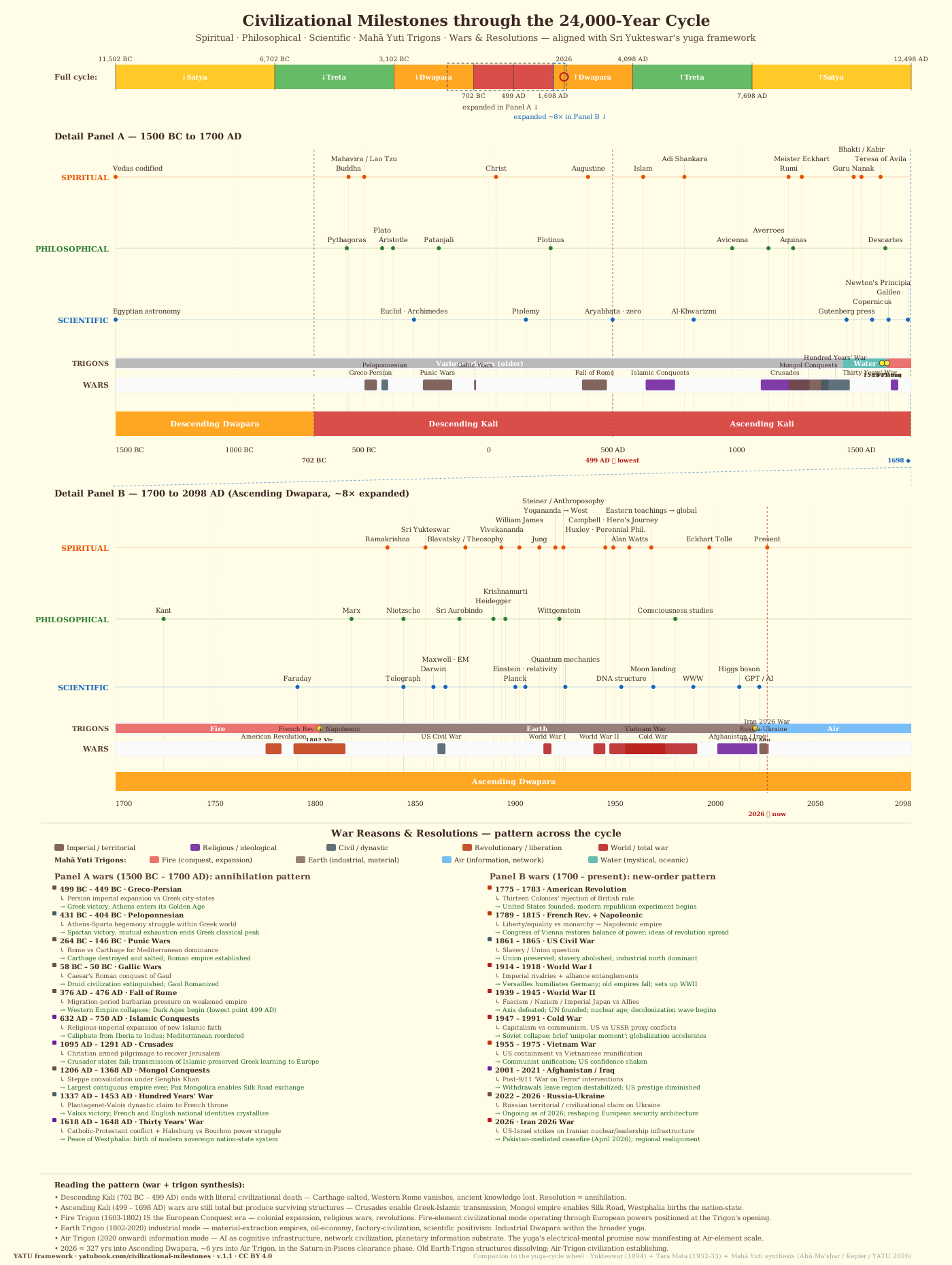
The empirical record — spiritual, philosophical, scientific, statecraft, and war milestones from 1500 BC to 2098 AD — read through Sri Yukteswar's restored yuga calendar. Cycle phase determines the resolution mode of war. Descending Kali ends in annihilation. Ascending Kali produces surviving structures. Ascending Dwapara produces new-order resolutions.
How to read this chart
The framework's interpretive logic, layered on top of the empirical pattern.
Core claim. Cycle phase determines the resolution mode of war, not its occurrence. War happens in every age. What changes across the 24,000-year breath is what the war produces at its conclusion — and that change is the strongest visible signature of cycle phase that exists in the historical record.
Yukteswar's 1894 calendar locates every event on this chart inside one of four phases of the descending arc or four of the ascending arc. The four detail-panel phases the timeline focuses on are Descending Dwapara (the late residue, 1500–702 BC), Descending Kali (702 BC–499 AD), Ascending Kali (499–1698 AD), and Ascending Dwapara (1698 AD onward). The pivot at 499 AD is the floor of the cycle — minimum pranic supply, maximum density. The pivot at 1698 AD is when the arc turned upward into Dwapara. We are 328 years past that turn, in the Kali sub-phase (1900–2100 CE) of ascending Dwapara — the densest, slowest-vibration sub-period inside an ascending major age. This is the only place on the cycle where descending-Kali templates can still run residually inside an ascending arc, which is why the 2020s carry both descending-residue and ascending-onset signatures simultaneously.
Three resolution modes — what cycle phase produces at the end of each war
Annihilation
The arc moves away from Bishnunavi. Pranic supply diminishes year over year. Civilizations cannot metabolize conflict because the substrate to metabolize with is itself contracting. Wars end in literal substrate termination — Carthage salted, the Druid civilization extinguished, the Library of Alexandria burnt, Western Rome dissolved into migration chaos. The structural function: dissolution-of-forms. The descending arc’s job is to break down crystallized structures so that the floor can be reached cleanly. 499 AD = the floor = nothing survives intact except whatever was already distributed, embodied, hidden, or carried in lineage rather than in institution.
Surviving structures
The arc has turned upward. Pranic supply begins climbing — slowly, because Kali is still Kali — but the direction has reversed. Wars are still total, but for the first time they begin to produce surviving structures on the way out. Crusades fail militarily but transmit Islamic-preserved Greek learning to Europe and seed the Renaissance. Mongol conquest is the largest contiguous land empire ever assembled, but Pax Mongolica reopens the Silk Road. Westphalia 1648 ends the Thirty Years’ War with the birth of the modern nation-state. The Bhakti revival happens during the worst of the Kali warfare — the L4–L5 substrate stays alive in distributed format precisely because concentrated institutions were vulnerable. The structural function: preservation-through-distribution.
New-order architecture
Pranic supply is now sufficient that conflict can be metabolized into more sophisticated form rather than terminating in ash. Every major Dwapara war resolves into more institutional architecture than existed before it began. American Revolution → United States Constitution. Napoleonic Wars → Congress of Vienna → balance-of-power. WWI → League of Nations (the failed seed). WWII → United Nations + Universal Declaration of Human Rights + Marshall Plan + EU + decolonization wave. Cold War → globalization + planetary governance attempts. Every war produces a more conscious institutional form than what preceded it. The structural function: structural evolution through pressure.
Wars in ascending Dwapara cannot end in annihilation because the cycle phase doesn’t supply the descending energy that annihilation requires. The substrate refuses to support it.
The seven-organ overlay on the war pattern
Every war on the chart maps to a specific civilizational-organ tension. Reading the war through the organ producing it clarifies whether the conflict is the organ’s gift mode or its shadow mode operating.
The Bhog–Daan–Naash overlay — every war’s resolution depends on whether the victor integrates Daan
The cycle phase doesn’t just determine whether resolution mode is annihilation, surviving-structure, or new-order. It determines whether the winning side integrates Daan into the resolution architecture. Bhog without Daan produces Naash. The cycle’s structural function in ascending phases is not to abolish war but to make Daan-integration into the resolution structurally rewarded and Daan-skipping structurally penalized.
Two visible cases on the chart make this concrete:
Versailles 1919. The Treaty extracted Bhog from Germany without integrating Daan — humiliation, reparations, territorial loss, no rebuilding architecture. The framework’s prediction (and history’s confirmation): Daan-skipping in an ascending-arc resolution produces structural Naash within one generation. World War II followed twenty years later as the necessary Naash discharge.
Post-WWII Marshall Plan. The opposite move. The same Allied victors who could have repeated Versailles instead extracted Bhog from victory and converted it to Daan — $13 billion (about $200 billion in 2026 dollars) of reconstruction aid to Europe, including to Germany itself; the United Nations as institutional Daan; the Universal Declaration of Human Rights as conceptual Daan; the Bretton Woods architecture; the decolonization wave that dissolved the European empires across the next thirty years. Result: seventy-five years of relative peace among the major powers, the longest such interval in Western civilizational history. Daan-integration in an ascending-arc resolution produces durable peace. Daan-skipping does not.
Every war on the chart can be read this way. The Crusades skipped Daan in form (extraction, conversion, slaughter) but produced Daan accidentally through the transmission of Islamic-preserved Greek learning back to Europe. The Mongol Empire integrated Daan operationally (Pax Mongolica, religious tolerance, Silk Road safety) and produced disproportionate civilizational gain relative to the destruction of conquest. The Cold War ended without Daan-integration (no Marshall Plan for the post-Soviet space) — and the resulting unintegrated Naash is part of what the Russia-Ukraine war 2022 onwards is discharging.
The 2026 reading — what the cycle is producing now
We are 328 years into Ascending Dwapara, in its Kali sub-phase. The 2020s carry descending-Kali templates discharging through an ascending-Kali sub-phase. WWI, WWII, the Cold War, the post-9/11 wars, Russia-Ukraine, and the 2026 Iran war are all readable as descending-Kali templates running residually inside an ascending arc.
The cycle predicts these conflicts cannot sustain themselves at descending-phase scale. The energy required is unavailable. They will resolve into new institutional architecture, not into annihilation. The Pakistan-mediated April 2026 ceasefire that closed the Iran war is already the cycle producing the new-order pattern in compressed form — the architecture sustaining the Velayat-e-Faqih warfare exhausted itself, and a substrate-aware mediator (not a victor, not a hegemon) closed the conflict.
The strongest single piece of evidence the chart carries is the post-1698 row of scientific milestones — Faraday, Maxwell, Einstein, quantum mechanics, DNA, AI. Sri Yukteswar predicted in 1894 that the modern age would “conquer the Maya of Space — annihilation of distance, matter recognized as energy.” That prediction has now been falsifiable for 132 years. The empirical record validates it cleanly. This is the framework’s most successful out-of-sample prediction, and it’s why the cycle’s structural reading of the war pattern deserves the same epistemic weight that any empirically-validated theoretical framework deserves.
“Peace is what the cycle structurally produces when the architecture sustaining war can no longer sustain itself, and when the resolution integrates Daan rather than skipping it.”
Profiles cited on this timeline
Each named figure on the chart — spiritual, philosophical, scientific — is profiled below in three parts: an empirical biographical paragraph (Wikipedia-grounded, original phrasing), a framework reading of how the figure’s contribution maps to cycle phase / civilizational organ / L1–L5 layer, and a Wikipedia sameAs anchor for entity-graph hydration. War events follow the same shape with resolution-mode + Daan-integration framing.
Each profile carries three parts: an empirical paragraph (Wikipedia-grounded, original phrasing), a framework reading in italic (cycle phase / civilizational organ / L1–L5 layer / resolution mode as appropriate), and a Wikipedia sameAs anchor. The three layers together make each profile both empirically verifiable and structurally legible through the YATU lens.
Incarnation lineage — beyond measurable scale
Figures whose structural significance the framework reads as cycle pivots rather than data points — incarnations, mahavatars, and lineage founders whose impact transcends conventional measure. Recognized across multiple traditions; tier reading is framework-internal.
Ram Chandra (Lalaji) Maharaj (1873–1931 · Sahaj Marg / Pranahuti yoga)
Founder of the Sahaj Marg lineage. Banker by profession; disciple of Sufi master Maulvi Fazl Ahmad Khan. Refined pranahuti — the technique of yogic transmission via the heart. Founder of what became Heartfulness globally. Framework reading: Anchor + Sufi-Mediterranean cross-organ incarnation embodying ascending-Dwapara consciousness work as householder, heart-based, transmission-by-presence. Lalaji's pranahuti — direct heart-to-heart energetic communication — is the cycle's L4–L5 substrate distilled to its most essential, institution-independent form. Hindu and Sufi substrates integrate at the consciousness layer, prefiguring the framework's seven-organ planetary integration. Wikipedia ↗
Ram Chandra (Babuji) Maharaj (1899–1983 · Sahaj Marg / Sri Ram Chandra Mission)
Lalaji's spiritual successor. Founded Sri Ram Chandra Mission (1945). Codified Sahaj Marg meditation system. The lineage transmitted pranahuti to millions globally, now operating as Heartfulness. Framework reading: Anchor-organ incarnation continuing Lalaji's cross-substrate transmission into the Kali sub-phase of ascending Dwapara. Babuji's organizational structure — Sri Ram Chandra Mission as distributed transmission network rather than centralized doctrinal institution — is the cycle's preferred form for ascending-arc consciousness work. Heart-based meditation made empirically practiceable at planetary scale. Wikipedia ↗
Bhagwan Swaminarayan (1781–1830 · Swaminarayan Sampradaya)
Founder of the Swaminarayan Sampradaya. Followers consider him Purushottam Narayan — supreme deity manifest. His lineage now operates as multiple branches including BAPS, which has built Akshardham temples globally and codified the modern mandir economy. Framework reading: Anchor-organ incarnation operating at early ascending Dwapara. Swaminarayan's reform — ethical conduct codified into devotional practice, anti-caste-discrimination, women's rights advocacy, structured social uplift — encodes the cycle's structural requirement that ascending-arc consciousness work integrate Daan into everyday social fabric. The Akshardham temple network is the framework's mandir economy concept made physically manifest at planetary scale, prefiguring the modern Anchor's substrate reactivation by two centuries. Wikipedia ↗
Guru Arjan Dev (1563–1606 · Sikhism / 5th Guru)
Fifth Sikh Guru. Compiled the Adi Granth (1604) — textual foundation of the Guru Granth Sahib. Built the Harmandir Sahib (Golden Temple). First Sikh martyr, executed under Mughal Emperor Jahangir in 1606. Framework reading: Anchor-organ incarnation establishing the Sikh tradition's textual and architectural substrate during peak ascending-Kali Mughal expansion. The Adi Granth's compilation — including verses from Hindu and Muslim saints across regions and castes — is the framework's clearest pre-modern instance of cross-substrate Daan integration codified into scripture. His martyrdom seeded the dharmic-resistance template that would define Sikhism through the next century. Wikipedia ↗
Guru Tegh Bahadur (1621–1675 · Sikhism / 9th Guru)
Ninth Sikh Guru. Martyred in Delhi (1675) by Aurangzeb after defending the religious freedom of Kashmiri Hindu Pandits. Honoured as 'Hind ki Chadar' — Shield of India. Framework reading: Anchor-organ incarnation establishing the dharmic principle that protection of others' religious freedom is itself a sacred obligation, even at cost of one's own life. The framework reads this as the cycle's structural production of cross-substrate solidarity at the moment when descending-arc religious-political fragmentation reached its peak. This template directly grounds India's later constitutional commitment to Dharmic Pluralism. Wikipedia ↗
Guru Gobind Singh (1666–1708 · Sikhism / 10th Guru / Khalsa Panth)
Tenth and final human Sikh Guru. Founded the Khalsa Panth (1699). Wrote Dasam Granth. Lost all four sons to Mughal persecution. Closed the human Guru lineage by declaring the Guru Granth Sahib eternal Guru in 1708. Framework reading: Anchor-organ incarnation completing the Sikh transmission template. The Khalsa institutionalized saint-soldier dharma — the recognition that ascending-arc consciousness work in a hostile descending-arc environment requires both spiritual practice and physical protection capacity. Closing the human Guru lineage to the Guru Granth Sahib is the framework's clearest example of distributed scriptural authority replacing concentrated personal authority — exactly the cycle's preferred ascending-arc form. Wikipedia ↗
Statecraft — civilizational stewards across the cycle
Political agents who measurably altered the cycle's resolution mode in their era — figures whose decisions consolidated dharma-aligned governance, integrated Daan into post-conflict architecture, or held substrate against descending-arc disruption. Strict criterion: structural transformation, not just historical fame.
Cyrus the Great (~600–530 BC · Achaemenid Persia)
Founder of the Achaemenid Empire. Cyrus Cylinder — first known charter of human rights. Liberated the Jews from Babylonian captivity (539 BC); celebrated as God's anointed in Isaiah. Framework reading: Persian Bridge organ's foundational statecraft template. Cyrus established the original 'tolerant emperor' pattern — multi-ethnic, multi-religious imperial governance without forced homogenization. The Cyrus-Isaiah substrate connection is the structural prefiguring of the Persian Bridge's reactivation in the post-2026 cycle phase. Empire-as-Daan-integration at the descending-Kali threshold. Wikipedia ↗
Bimbisara (~558–491 BC · Magadha kingdom)
King of Magadha during Buddha's lifetime. Patron and disciple of the Buddha. Built the foundation of Magadha as the dominant North Indian power. Framework reading: Anchor-organ figure demonstrating dharmic governance at the descending-Kali onset. Bimbisara's patronage of both the Buddha and Mahavira — Axial Age cluster contemporaries — exemplifies the cycle's structural pairing of statesmanship with spiritual transmission at major phase transitions. Wikipedia ↗
Kharavela of Kalinga (~209–170 BC · Mahameghavahana dynasty)
Kalinga king who restored eastern Indian sovereignty after Mauryan absorption. Hathigumpha inscription is among the earliest extensive royal autobiographies. Major Jain patron. Framework reading: Anchor-organ regional ruler demonstrating the cycle's structural protection of distributed political and religious substrate even during peak descending Kali. Kharavela's Jain patronage and explicit autobiographical record (rare in Indic statecraft) preserved Odisha's distinctive substrate that Mauryan/Gupta consolidation had not erased. Wikipedia ↗
Chandragupta Maurya (~340–297 BC · Mauryan Empire)
Founder of the Mauryan Empire under Chanakya's counsel. First pan-Indian unification. Renounced kingship at the end of his life and became a Jain ascetic. Framework reading: Anchor-organ founder of the first geographically integrated Indian state. The Mauryan template — strong central administration paired with Chanakya's Arthashastra political-economic theory — is the substrate Patel would later restore at independence. Chandragupta's renunciation at the end of his reign signals the cycle's structural preference for governance subordinated to dharmic recognition. Wikipedia ↗
Ashoka the Great (~304–232 BC · Mauryan Empire / Buddhist patronage)
Mauryan emperor whose post-Kalinga conversion to Buddhism transformed his rule. Edicts of Ashoka — the world's earliest preserved royal commitment to non-violence and pluralist tolerance. Ashokan wheel sits at the center of the modern Indian flag. Framework reading: The framework's clearest single demonstration that even peak descending-Kali conquest could metabolize Naash into Daan. Ashoka's transformation after Kalinga is the cycle's structural template for ruler-conscience: military victory recognized as moral defeat, conquest converted into dharmic governance. The Ashokan wheel as state symbol of the modern Indian republic shows how deep this template runs in the Anchor's substrate. Wikipedia ↗
Han Wudi (Emperor Wu of Han) (157–87 BC · Western Han Dynasty)
Han Dynasty emperor who codified Confucianism as state ideology, opened the Silk Road via Zhang Qian's missions to Central Asia, and consolidated Chinese imperial governance for two millennia. Framework reading: Perfectionist organ's foundational statecraft template. Han Wudi's institutional integration of Confucian moral philosophy with imperial administration created the Saturn-Kubera operating system the framework names structurally. Silk Road opening via Zhang Qian is the first major Persian Bridge ↔ Perfectionist civilizational connection. Wikipedia ↗
Marcus Aurelius (121–180 AD · Roman Stoicism)
Roman emperor and Stoic philosopher. The Meditations — private journal of Stoic practice never intended for publication — became one of the most enduring works of contemplative philosophy in Western tradition. Framework reading: Consumer organ (proto-European) figure operating at the descending-Kali floor. The Meditations are the highest-Daan philosophical articulation the descending arc could produce — embodied Stoic practice at the peak of Roman imperial concentration, just before institutional collapse. The cycle's structural production of the philosopher-king at the moment substrate would soon dissolve. Wikipedia ↗
Chandragupta I (~320–335 AD · Gupta Empire founder)
Founder of the Gupta Empire. Re-established North Indian sovereignty after centuries of fragmentation following the Mauryan collapse. Framework reading: Anchor-organ figure beginning the Gupta restoration just before the descending-Kali to ascending-Kali pivot. The Gupta consolidation enabled the Indian Golden Age that would peak under his successors — the substrate visibly reorganizing as the cycle approaches its floor and prepares to ascend. Wikipedia ↗
Samudragupta (~335–380 AD · Gupta Empire expansion)
Gupta emperor whose military campaigns extended the empire across most of the Indian subcontinent. Patron of arts and Sanskrit literature; called the 'Indian Napoleon' by some 19th-century historians. Framework reading: Anchor-organ figure consolidating substrate at the cycle floor. Samudragupta's pan-Indian extension was structurally preparatory — building the institutional carriers that would peak under Vikramaditya and seed cultural output across the next millennium. Wikipedia ↗
Chandragupta II Vikramaditya (~380–415 AD · Gupta Empire / Indian Golden Age)
Gupta emperor under whom India entered its Golden Age. Court of the navaratnas (nine jewels) including Kalidasa. Aryabhata flourished in the same period. Indian mathematics, astronomy, art, literature reached high points that would shape civilizations across Asia for centuries. Framework reading: Anchor-organ peak of the Indian Golden Age occurring precisely at the descending-Kali floor (~400 AD). The framework reads this as the cycle's structural production of substrate concentration just before the long ascending climb — Sanskrit literature, astronomy, mathematics codified in forms that would survive through the entire ascending Kali period and seed both the Islamic Golden Age and eventual European Renaissance. Wikipedia ↗
Constantine the Great (272–337 AD · Roman / early Byzantine)
Roman emperor who legalized Christianity (Edict of Milan, 313 AD), founded Constantinople as the eastern Roman capital, convened the Council of Nicaea (325 AD). Framework reading: Sufi-Mediterranean / Diasporic Bridge figure operating at the descending-Kali floor. Constantine's structural function was substrate-preservation through institutional pivot: Western Rome was about to dissolve; Christianity provided the L4–L5 substrate that would survive the institutional collapse and re-emerge through monasticism, scholasticism, and eventually the Renaissance. Wikipedia ↗
Tang Taizong (598–649 · Tang Dynasty)
Second Tang emperor; consolidated the dynasty after civil war. Reign of Zhenguan (626–649) is considered the model of good Chinese governance. Patron of Buddhism, Confucian scholarship, and Silk Road trade. Framework reading: Perfectionist organ figure operating just past the cycle floor. Tang Taizong's Confucian-Buddhist synthesis governance is the framework's clearest pre-modern instance of ascending-Kali surviving-structures pattern: the Tang held substrate intact while Western Eurasia was still dissolving, enabling Buddhism's preservation, Silk Road connectivity, and the cultural template that would define East Asia for the next millennium. Wikipedia ↗
Lalitaditya Muktapida (~724–760 AD · Karkota dynasty / Kashmir)
Karkota dynasty Kashmiri king. Built the Martand Sun Temple — one of the most architecturally significant pre-Islamic Hindu temples in the subcontinent. Extended Kashmir's reach across northern India. Framework reading: Anchor-organ figure consolidating Kashmir as cultural-spiritual node before Islamic disruption of the northwestern substrate. Martand's architectural sophistication demonstrates ascending-Kali Anchor preservation in regions still operating outside the descending-arc invasion path. Wikipedia ↗
Charlemagne (~747–814 · Carolingian Empire)
King of the Franks (768) and Lombards (774); crowned Emperor of the Romans (800). Carolingian renaissance — preservation and standardization of classical Latin texts, monastic scholarship, vernacular literacy. Framework reading: Consumer organ figure establishing the first Vayu-regulator structure of the ascending arc. Charlemagne's institutional consolidation gave Western Europe a coherent political-cultural frame after centuries of post-Roman fragmentation. The Carolingian renaissance is the cycle's structural preservation move — copying classical texts into monastic libraries that would survive the next millennium. Wikipedia ↗
Rajaraja Chola I (~947–1014 · Chola Empire)
Chola emperor who built the Brihadeeswara Temple at Thanjavur — UNESCO World Heritage Site, summit of South Indian temple architecture. Naval campaigns extended Chola reach across southern India and Sri Lanka. Framework reading: Anchor-organ peak in the southern parampara. Rajaraja's Brihadeeswara is the framework's clearest single demonstration of ascending-Kali stone-substrate preservation: the temple has functioned continuously for over a thousand years, surviving every subsequent political disruption. The Anchor's structural preference for distributed regional centres of cultural concentration visible at architectural scale. Wikipedia ↗
Rajendra Chola I (~971–1044 · Chola Empire)
Son of Rajaraja Chola I. Mounted naval expeditions to Southeast Asia (Srivijaya, 1025), extending Chola influence across the Bay of Bengal and into the Malay peninsula. Built Gangaikonda Cholapuram as new capital. Framework reading: Anchor-organ figure projecting the Indian substrate eastward into Storehouse territory (Southeast Asia). The Chola maritime expansion is the framework's clearest pre-modern Anchor-Storehouse civilizational connection — Hindu and Buddhist substrate flowing through trade and royal patronage networks. Cultural transmission still visible in Angkor Wat's iconography and contemporary Indonesian Hinduism. Wikipedia ↗
William the Conqueror (~1028–1087 · Norman Conquest)
Duke of Normandy who conquered England in 1066 (Battle of Hastings) and established Norman rule. Domesday Book (1086) — comprehensive royal survey of land and resources. Identified by Paramahansa Yogananda as one of his prior incarnations. Framework reading: Consumer organ figure establishing English administrative-state structure that would become foundational to subsequent European institution-building. Domesday Book is the cycle's structural production of the first systematic state-information apparatus. Yogananda's identification of William as one of his past incarnations adds a framework-internal note: the soul-trajectory from European royal-administrative work to ascending-Dwapara consciousness-transmission work spans 800 years and reflects the cycle's preference for souls who graduate institutional substrate work into spiritual transmission work. Wikipedia ↗
Henry IV (Holy Roman Emperor) (1050–1106 · Holy Roman Empire / Investiture Controversy)
Holy Roman Emperor whose conflict with Pope Gregory VII over investiture (right to appoint bishops) became the defining test of secular-vs-papal authority in medieval Europe. Walk to Canossa (1077) — historic moment of imperial humiliation. Framework reading: Consumer organ figure embodying the first major secular-state structural challenge to papal monopoly. The Investiture Controversy is the cycle's structural production of the long European argument over whether spiritual and political authority can be centralized in a single institution. The eventual answer — they cannot — is what enabled the European separation of church and state. Wikipedia ↗
Frederick II Hohenstaufen (1194–1250 · Holy Roman Empire / Sicilian renaissance)
Holy Roman Emperor known as 'Stupor Mundi' (Wonder of the World). Multilingual scholar-king. Multi-faith court at Palermo with Christian, Jewish, and Islamic scholars. Repeatedly excommunicated by the papacy. Diplomatic recovery of Jerusalem (1229) without bloodshed. Framework reading: Consumer organ figure operating at the Sicilian seam between Christian Europe and Islamic Mediterranean. Frederick's court is the framework's clearest medieval European instance of cross-organ Daan integration — actively translating Arabic philosophy, hosting Jewish and Muslim scholars, refusing the descending-arc Crusader pattern. His repeated excommunications mark the structural cost of operating outside descending-arc religious-political binary. Wikipedia ↗
Narasimhadeva I (~1238–1264 · Eastern Ganga dynasty / Odisha)
Eastern Ganga dynasty king. Built the Konark Sun Temple (~1250) — UNESCO World Heritage Site, masterpiece of Kalinga architecture. Defended Odisha against the Delhi Sultanate's eastward expansion. Framework reading: Anchor-organ regional ruler preserving eastern Indian substrate during the period when the Sultanate's expansion was destroying temple complexes across northern India. Konark's architectural ambition at the height of the Sultanate threat is the cycle's structural production of substrate-defiance through stone — what the descending arc cannot reach, the cycle protects. Wikipedia ↗
Kublai Khan (1215–1294 · Yuan Dynasty / Mongol Empire)
Founder of the Yuan Dynasty (1271). Grandson of Genghis Khan. Conquered Song China and unified northern and southern China for the first time in centuries. Pax Mongolica enabled Silk Road revival, Marco Polo's journey, the largest contiguous land empire in human history. Framework reading: Tie-Breaker organ proto-figure (the Mongol substrate that later flowed into Russian Tie-Breaker function). Kublai's Yuan rule is the framework's clearest demonstration of the ascending-Kali surviving-structures pattern at scale: the Mongol conquest was destructive yet produced Pax Mongolica — Silk Road connectivity, technological exchange across Eurasia, the structural preconditions for the Renaissance. Wikipedia ↗
Krishnadevaraya (~1471–1529 · Vijayanagara Empire)
Vijayanagara emperor at the empire's peak. Patron of Telugu, Kannada, Sanskrit, Tamil literature simultaneously. Hampi at his time was one of the largest cities in the world. Last great Hindu empire before Mughal climax. Framework reading: Anchor-organ peak preservation moment in the southern parampara. Vijayanagara's century-and-a-half existence (1336–1565) under the protection of figures like Krishnadevaraya kept dharmic governance, temple culture, and Sanskrit-Dravidian literary patronage alive precisely as northern India was being absorbed into Sultanate and Mughal polities. Wikipedia ↗
Martin Luther (1483–1546 · Protestant Reformation)
German theologian whose 95 Theses (1517) catalyzed the Protestant Reformation. Translation of the Bible into vernacular German; insistence on individual conscience over institutional clerical authority. Direct line from Luther through 200 years of religious wars to the Peace of Westphalia (1648) and the modern nation-state. Framework reading: Consumer organ figure breaking the papal monopoly that Henry IV had only partially challenged. Luther's structural function in the framework: distributing scriptural authority into vernacular and individual hands, breaking the Roman Catholic concentration that descending-arc Europe had relied on for institutional substrate. The cycle's preference for distributed authority over concentrated authority visible at religious-institutional scale. Wikipedia ↗
Shivaji Bhosale (1630–1680 · Maratha Empire founder)
Founder of the Maratha kingdom; crowned Chhatrapati at Raigad in 1674. Carved an independent Hindu state from declining Mughal/Bijapur control. Famous for explicit codes of conduct in war — protection of women, religious sites, and non-combatants. Framework reading: Anchor-organ substrate counter-pulse against ascending-Kali Mughal expansion. Demonstrates the framework's claim that the Anchor's parampara survives concentrated invasion via distributed cultural durability — and when descending pressure begins to ease, re-emerges in coherent governance form. Daan-integration encoded in actual military practice — the cycle's ethical demand visible at the level of how a war is conducted. Wikipedia ↗
Peter the Great (1672–1725 · Tsardom of Russia / Russian Empire)
Tsar of Russia who Westernized the empire — built St. Petersburg, modernized military and bureaucracy, established the Russian Navy. Personally traveled in disguise through Western Europe to study shipbuilding and statecraft. Framework reading: Tie-Breaker organ figure executing the first major synthesis attempt at the dawn of ascending Dwapara. Peter's Westernization is the framework's clearest demonstration of the Tie-Breaker's structural function — absorbing what other organs cannot stomach and casting it as transformative state-building. St. Petersburg as physical instantiation: a city built on swamp by tsarist will, oriented toward the Consumer organ for civilizational dialogue. Wikipedia ↗
Catherine the Great (1729–1796 · Russian Empire)
Empress of Russia. Patron of the arts and Enlightenment correspondence (Voltaire, Diderot). Massive territorial expansion (Crimea, Black Sea, Polish partitions). Founded the Hermitage. Framework reading: Tie-Breaker organ figure continuing Peter's Westernization through enlightened despotism. Catherine's reign is the framework's case study in the Tie-Breaker's capacity to absorb European cultural-philosophical substrate without surrendering Russian civilizational distinctiveness. The territorial expansion southward into Crimea set up structural tensions that would replay through every subsequent century — culminating in the 2022 Russia-Ukraine war. Wikipedia ↗
George Washington (1732–1799 · United States founding)
Commanding general of the Continental Army. First President of the United States (1789–1797). Voluntarily relinquished power after two terms — establishing the peaceful transition of power as constitutional template. Refused monarchy multiple times. Framework reading: Experimenter organ's foundational statecraft figure. Washington's structural contribution to ascending Dwapara: the peaceful transition of power as governance template. By voluntarily stepping down at the end of two terms, he created the institutional pattern that distinguishes ascending-Dwapara democracy from the autocratic forms that preceded it. The cycle's clearest single demonstration that political authority can be ceded without violence. Wikipedia ↗
Maharaja Ranjit Singh (1780–1839 · Sikh Empire)
Founder of the Sikh Empire (1801–1839). Unified the Sikh misls; conquered Lahore. Multi-religious administration — Hindus, Muslims, Sikhs, and Christians all held high posts. No forced conversions. Restored peace and infrastructure to a region devastated by centuries of invasions. Framework reading: Anchor-organ figure consolidating Punjab as the northwestern frontier against further descending-arc disruption. Demonstrates ascending-Dwapara new-order resolution mode operating via Sikh dharma's middle-path Daan-integration. The Khalsa's encoded religious pluralism is structurally what the cycle phase asks for — Dharmic Pluralism (sarva dharma sambhava) rather than Western-style secularism. Direct predecessor template to the Dharmic Pluralist republic Patel and the constitutional order would establish a century later. Wikipedia ↗
Abraham Lincoln (1809–1865 · United States / Union preservation)
16th President of the United States. Led the Union through the Civil War (1861–1865). Emancipation Proclamation (1863). Assassinated April 1865. The Gettysburg Address — the most consequential short speech in American political history. Framework reading: Experimenter organ figure passing the cycle's first major existential test of ascending Dwapara — the substrate held, slavery was abolished, the Union survived. Magnet-mode operating against Empire-mode under the most extreme internal pressure. The cycle's structural production of moral leadership at the moment when the constitutional template Washington had established faced its first life-or-death challenge. Wikipedia ↗
Maharaja Sayajirao Gaekwad III (1863–1939 · Baroda princely state)
Maharaja of Baroda 1875–1939. Abolished untouchability in his state. Made primary education free and compulsory. Established Baroda Bank. Sponsored Bhimrao Ambedkar's higher education. Supported Aurobindo's early career. Modernized administration and infrastructure. Framework reading: Anchor-organ reformist ruler operating from within the surviving princely-state structure during late British colonial period. Demonstrates that even fragmented Anchor governance could produce ascending-arc Daan-integration when consciousness met opportunity. Predecessor template for post-independence reformist statecraft — and the figure who funded the higher education of Ambedkar, the Constitution's chief architect, materially seeding the Republic that would emerge. Wikipedia ↗
Sun Yat-sen (1866–1925 · Republic of China founding)
Founder of the Republic of China (1912). Articulated the Three Principles of the People — nationalism, democracy, welfare. Ended over two millennia of imperial Chinese rule. Framework reading: Perfectionist organ figure executing the structural transition from imperial form to republican form at the dawn of the Kali sub-phase. Sun Yat-sen's Three Principles articulated a Chinese ascending-Dwapara political philosophy — synthesizing Western republican forms with Confucian-derived concepts of social welfare. The Republic's continuity through Taiwan demonstrates the framework's structural protection of the substrate. Wikipedia ↗
Mohandas Gandhi (1869–1948 · Satyagraha / Indian independence)
Architect of satyagraha (truth-force / non-violent resistance) as political technique. Led the Indian independence movement from 1915 to 1947. Framework reading: Most YATU-distinctive figure on the Statecraft row. The Anchor's leaders had historically been localized — Cholas in the south, Marathas in the west, Sikhs in the northwest, regional dynasties across the subcontinent. The framework reads this fragmentation structurally: the Anchor's preservation function always flowed through distributed regional centres rather than concentrated central authority — and a single united political figure was structurally hard to produce. Gandhi was the first single personality across Anchor history with coverage in every state — the first figure who could mobilize the entire subcontinent under one political-spiritual gravity. He brought the Anchor from its multi-millennium fragmented condition into a united body capable of fighting colonial occupation, and simultaneously set the operating template for what the Anchor would do next: motherly service to the world — preservation, transmission, nurture — aligned to the Anchor's civilizational nature. Satyagraha as method demonstrated that ascending-arc consciousness work could scale directly to political action — L4–L5 substrate (truth, non-violence, dignity) as operational toolkit of a mass movement, not just contemplative practice. Wikipedia ↗
Franklin D. Roosevelt (1882–1945 · United States / New Deal / WWII / UN)
32nd President of the United States. Architected the New Deal (1933) in response to the Great Depression. Led the US through World War II. Conceived the United Nations as post-war institutional architecture. Died April 1945. Framework reading: Experimenter organ figure embodying ascending Dwapara's new-order-resolution mode at planetary scale. FDR is the framework's clearest single demonstration of the cycle's structural preference for institution-building under crisis pressure: depression → New Deal; world war → UN, Bretton Woods, Universal Declaration of Human Rights. Every major resolution he architected produced more sophisticated institutional substrate than what preceded it. Wikipedia ↗
Winston Churchill (1874–1965 · United Kingdom / WWII)
Prime Minister of the United Kingdom 1940–1945 and 1951–1955. Led Britain through World War II. Speeches in 1940 functioned as substrate-protection at civilizational scale. Framework reading: Consumer organ figure holding the L4 line during the cycle's hardest fascist test. Churchill's structural function: preservation of the European democratic substrate against descending-Kali totalitarian pressure. Without that preservation, FDR's new-order architecture would have had no European partner to build with. The Consumer's Vayu-regulator function preserving institutional continuity through the moment when concentrated descending-arc force came closest to extinguishing it. Wikipedia ↗
Sardar Vallabhbhai Patel (1875–1950 · Indian independence / republic founding)
Indian independence leader, 'Iron Man of India.' First Deputy Prime Minister and Home Minister of independent India. Integrated 565 princely states into the Republic of India between 1947–1949 through diplomacy and selective force. Framework reading: The Anchor's structural unification at independence. Without Patel's integration of the princely states, the Republic would have been a patchwork of suzerainties. The framework's claim that ascending-Dwapara new-order resolutions consolidate substrate at the right cycle moment is most cleanly visible here. Patel is the territorial Daan-integrator that makes everything that follows in the modern Indian state possible — the structural counterpart to George Marshall's institutional architecture work in the Experimenter organ at the same moment. Wikipedia ↗
George C. Marshall (1880–1959 · Marshall Plan / post-WWII reconstruction)
Chief of Staff of the US Army during WWII. As Secretary of State (1947–1949), architected the Marshall Plan — $13 billion in aid to rebuild post-war Europe. Nobel Peace Prize 1953. Framework reading: The framework's cleanest single example of ascending-Dwapara new-order-resolution mode operating in a single career. Marshall translated victorious-power Bhog (American post-WWII economic dominance) into Daan (rebuilding the defeated and devastated) — the cycle's structurally preferred path. The Marshall Plan is the most-cited concrete instance the framework can offer that ascending-Dwapara wars produce more sophisticated institutional architecture than what preceded them. Patel's Indian counterpart at the same cycle moment. Wikipedia ↗
Martin Luther King Jr. (statecraft cross-listing) (1929–1968 · American Civil Rights / non-violent resistance)
American civil rights leader; advocate of Gandhian non-violent resistance applied to racial injustice in the United States. Letter from a Birmingham Jail (1963), 'I Have a Dream' speech (1963). Assassinated April 1968. Cross-listed on Spiritual row. Framework reading: Experimenter organ figure carrying the Anchor's satyagraha methodology back into the Experimenter substrate to integrate slavery's substrate damage. MLK is the framework's clearest demonstration of inter-organ consciousness-technology transfer: Gandhi's Anchor-developed technique applied operationally to American racial injustice. Cross-listed because his function operates at both Statecraft and Spiritual layers — the cycle's preferred form of leadership in the Kali sub-phase of ascending Dwapara. Wikipedia ↗
Lee Kuan Yew (1923–2015 · Singapore founding)
Founder of modern Singapore. Prime Minister 1959–1990. Transformed a small post-colonial port into one of the world's most successful city-states through technocratic governance, multi-cultural pluralism, and disciplined institution-building. Framework reading: Storehouse organ (Southeast Asia node) figure demonstrating ascending-Dwapara new-order resolution at concentrated city-state scale. Lee Kuan Yew's structural innovation: a multi-ethnic, multi-religious, technocratic polity that delivered sustained economic and institutional development without descending into the ethno-political fragmentation that captured most post-colonial states. Wikipedia ↗
Mikhail Gorbachev (1931–2022 · Soviet Union / glasnost / Cold War end)
Last leader of the Soviet Union. Glasnost (openness) and Perestroika (restructuring) policies precipitated the end of the Cold War, the fall of the Berlin Wall (1989), and the dissolution of the USSR (1991). Nobel Peace Prize 1990. Framework reading: Tie-Breaker organ figure executing the Cold War's closure without large-scale violence — pure ascending-Dwapara resolution mode at the planetary scale. The framework reads Gorbachev's choice not to use force in 1989 (when the Eastern Bloc collapsed) as the cleanest single decision-point demonstrating the cycle's structural preference for new-order resolution over annihilation. Wikipedia ↗
P.V. Narasimha Rao (1921–2004 · India / 1991 economic liberalization)
Prime Minister of India 1991–1996. Architected India's economic liberalization with Manmohan Singh as Finance Minister — ended the License Raj, opened the economy after the 1991 balance-of-payments crisis. Look East policy; normalized relations with Israel and ASEAN. Framework reading: Anchor-organ figure delivering pivotal new-order resolution at India's economic crisis moment. Demonstrates that ascending-Dwapara resolutions can come from quiet, technocratic statecraft — not just charismatic leadership. The fiscal-liberalization counterpart to Patel's earlier territorial integration: Patel made the Republic possible geographically; Rao made it possible economically. Wikipedia ↗
Nelson Mandela (1918–2013 · South Africa / Truth and Reconciliation)
South African anti-apartheid revolutionary; political prisoner 1962–1990 (27 years). First democratically elected President of South Africa (1994–1999). Architected the Truth and Reconciliation Commission process. Nobel Peace Prize 1993. Framework reading: Storehouse organ (Africa node) figure embodying the most distinctive ascending-Dwapara new-order resolution mode in modern history. Mandela's structural innovation: reconciliation as the new-order alternative to either annihilation or surviving-structures. The framework's clearest demonstration that civilizational trauma can be metabolized through truth-telling and Daan-integration rather than retributive Naash. Storehouse organ rising to planetary moral leadership precisely as descending-arc apartheid template exhausted itself. Wikipedia ↗
Atal Bihari Vajpayee (1924–2018 · India / BJP coalition era)
Three-time Prime Minister of India (1996, 1998, 1998–2004). Founding figure of the Bharatiya Janata Party. Pokhran-II nuclear tests (1998). Lahore bus diplomacy. Kargil War leadership. Golden Quadrilateral highways and Pradhan Mantri Gram Sadak Yojana — village road connectivity. First non-Congress PM to complete a full term. Framework reading: Anchor-organ bridge figure between the Nehru-era secular consensus and the Modi-era dharma-aligned reorientation. Vajpayee's structural function: demonstrating that the BJP could govern within the constitutional framework's Dharmic Pluralist body with broad coalition support — the proof-of-concept that the Anchor's plural governance, properly read, was always dharma-aligned rather than secular in the Western sense, and could absorb new political alignments without breaking. Infrastructure-as-substrate-investment (highways, rural roads) prefigures the digital-public-infrastructure and mandir-economy work of later administrations. Wikipedia ↗
Shinzo Abe (1954–2022 · Japan / Indo-Pacific strategic reset)
Longest-serving Prime Minister of Japan (2012–2020). Architected 'Abenomics.' Conceived the Free and Open Indo-Pacific framework. Co-architect of the Quad alliance with the US, India, and Australia. Assassinated July 8, 2022 in Nara during a campaign speech. Framework reading: Perfectionist organ (East Asia node) figure reactivating Japan's strategic agency in late ascending Dwapara. The Quad alliance Abe co-architected is the Perfectionist↔Anchor↔Experimenter↔Storehouse connectivity that the framework reads as ascending-Dwapara new-order resolution at planetary scale — Asia-Pacific institutional architecture replacing Cold War bipolarity. The Free and Open Indo-Pacific concept structurally parallels Modi's connectivity-to-bridge function. His 2022 assassination is itself a marker — descending-Kali template still firing residually inside the ascending-Dwapara Kali sub-phase, yet Japan's response was textbook new-order: institutional continuity, Quad framework continues under his successors. Wikipedia ↗
Narendra Modi (b. 1950 (PM 2014– ) · India / Anchor substrate reactivation)
Prime Minister of India since 2014. Major initiatives: digital public infrastructure (UPI, Aadhaar, ONDC), Goods and Services Tax (2017), Ayodhya Ram Mandir completion (2024), Article 370 abrogation (2019), Chandrayaan-3 lunar landing (2023), Quad alliance assertion, mandir economy revival via Kashi Vishwanath corridor + Char Dham connectivity. Framework reading: Anchor-organ figure re-establishing the lost connection to the Bridge organs and restarting the mandir economy for L4–L5 substrate work. The temple-centered community + commerce + pilgrimage network is L4 (heart/intuitive) and L5 (consciousness) substrate — physical infrastructure for ritual practice, embodied tradition, body-knowledge formats. The Anchor was never structurally secular in the Western sense; the framework reads it as inherently Dharmic Pluralist (sarva dharma sambhava). Modi's structural function is making this dharmic-substrate explicit again after the Nehruvian transitional period that obscured it. Connectivity-to-bridge: India's multi-vector foreign policy linking Anchor to Persian Bridge, Diasporic Bridge, Storehouse, and Perfectionist (via Quad). The framework's clearest contemporary demonstration that the Anchor's parampara, having survived 800 years of descending-arc disruption, is now in active substrate-reconstruction phase. Patel territorially integrated; Rao economically integrated; Modi is reactivating the substrate's spiritual-economic body. Change-makers always carry friction — the framework reads the substrate work, not the political weather. Wikipedia ↗
v1.1 expansion — gap-fill across organs
Targeted additions filling structural gaps in the framework's empirical scaffolding: trajectory-changing Experimenter scientists, the Diasporic Bridge organ's foundational figures, the Mormon religious tradition, and Tie-Breaker protector statecraft.
Nikola Tesla (1856–1943 · Electrical engineering / wireless)
Serbian-American inventor whose AC induction motor (1888) and polyphase electrical system became the foundation of the modern electrical grid. Pioneered wireless transmission, radio control, neon and fluorescent lighting. Held over 300 patents. Framework reading: Experimenter organ figure operating at the structural moment electricity became civilizational substrate. Tesla's AC system enabled the planetary electrification that the framework reads as Yukteswar's 1894 'electrical age' prediction made physical. The cleanest single-figure demonstration that ascending Dwapara's Experimenter organ produces trajectory-changing technology by attracting talent globally and giving it space to deploy. Wikipedia ↗
Thomas Edison (1847–1931 · Industrial invention)
Practical inventor of the long-lasting incandescent light bulb (1879), the phonograph (1877), and the motion picture camera. Founded the first industrial research laboratory at Menlo Park. Held 1,093 US patents. Framework reading: Experimenter organ figure who institutionalized invention as systematic industrial process. The Menlo Park laboratory was the first R&D lab — the structural template the Experimenter still uses to attract, space, protect, and deploy creative talent. Pair with Tesla as the cycle's Faustian bargain: industrial-scale problem-solving paired with unresolved ethical tensions about whose ideas get rewarded. Wikipedia ↗
Wright Brothers (1903 · Aviation)
Orville and Wilbur Wright achieved the first sustained powered flight on December 17, 1903 at Kitty Hawk. Solved three-axis control via wing warping — the structural breakthrough that made all subsequent aviation possible. Framework reading: Experimenter organ trajectory-changer. Powered flight is the cycle's structural delivery of literal annihilation-of-distance — the framework's reading of Yukteswar's 1894 prediction. Two bicycle mechanics from Dayton solved what funded research labs had failed at: the Experimenter's distinctive attract-space-deploy template operating at the level of individual practical talent. Wikipedia ↗
J. Robert Oppenheimer (1904–1967 · Theoretical physics / Manhattan Project)
Theoretical physicist who led the Manhattan Project's Los Alamos laboratory (1943–1945), delivering the atomic bomb. Read the Bhagavad Gita in Sanskrit; quoted 'Now I am become Death, the destroyer of worlds' on watching Trinity. Later became advocate for nuclear arms control; lost security clearance in 1954. Framework reading: Experimenter organ figure operating at the framework's most structurally consequential 20th-century moment. The atomic bomb is the cycle's clearest single instance of L1-L3 acceleration outpacing L4-L5 substrate maturity — a technology civilization developed without the consciousness to wield it ethically. Oppenheimer's lifelong reckoning with what he had unleashed (and his Bhagavad Gita reference at Trinity) is the framework reading made personal: Anchor wisdom traditions are exactly the substrate the Experimenter requires to metabolize what it produces. Wikipedia ↗
Steve Jobs (1955–2011 · Personal computing / mobile)
Co-founder of Apple. Macintosh (1984), iPod (2001), iPhone (2007), iPad (2010). Made his first pilgrimage to Neem Karoli Baba's ashram in Kainchi, India in 1974 at age 19; influence persisted across his life. Personal computing → mobile → app economy. Single most consequential American technology executive of the post-2000 era. Framework reading: Experimenter organ figure carrying explicit Anchor-substrate influence. Jobs' 1974 pilgrimage to Neem Karoli Baba and lifelong meditation practice is the framework's clearest demonstration of organ-cross-pollination at scale: Anchor-substrate consciousness work shaping the design language of Experimenter technology. The iPhone's aesthetic restraint — the framework reads it as the influence of contemplative training expressed through industrial design — has shaped every subsequent consumer technology. Wikipedia ↗
Maimonides (Moses ben Maimon) (1138–1204 · Jewish philosophy / Aristotelian rationalism)
Sephardic philosopher, physician, and codifier of Jewish law. The Mishneh Torah (1180) and Guide for the Perplexed (1190) integrated Aristotelian rationalism with rabbinic tradition. Influenced Aquinas and the entire scholastic philosophical project. Framework reading: Diasporic Bridge figure operating at peak ascending-Kali Andalusian convivencia. Maimonides exemplifies the Diasporic Bridge's structural function — carrying knowledge across geographies and traditions, translating between Greek philosophy and Hebrew scripture, simultaneously rabbinic authority and Aristotelian rationalist. The Bridge's substrate-preservation work made operationally visible. Wikipedia ↗
Baruch Spinoza (1632–1677 · Rationalist pantheism)
Dutch-Jewish philosopher excommunicated from Amsterdam's Sephardic community at 23 for heretical views. Earned his living grinding optical lenses while writing the Ethics (published posthumously, 1677) — a geometrically structured argument for substance-monism (Deus sive Natura). Framework reading: Diasporic Bridge figure embodying the structural cost of operating outside both descending-arc religious orthodoxy and emerging Western Cartesian dualism. Spinoza's Deus sive Natura ('God or Nature') is the framework's clearest pre-modern Western articulation of L4-L5 non-dual recognition — what the Anchor's Advaita tradition had been carrying for a millennium expressed in geometric Latin prose. The structural production of substrate that survives orthodoxy by refusing institutional capture. Wikipedia ↗
Theodor Herzl (1860–1904 · Zionism founder)
Austro-Hungarian journalist whose Der Judenstaat (1896) articulated political Zionism. Convened the First Zionist Congress at Basel in 1897 — '50 years from now everyone will know it: the Jewish State will exist.' Died 1904. State of Israel founded 1948 — almost exactly the 50-year prediction. Framework reading: Diasporic Bridge organ figure crystallizing the modern Zionist project. The framework reads the Diasporic Bridge as carrying memory across two millennia of dispersion; Herzl's contribution was articulating that the Bridge function structurally required a territorial body in the original Persian Bridge zone. The 50-year prediction becoming literally true is one of the framework's most empirically consequential single-figure forecasts. Wikipedia ↗
David Ben-Gurion (1886–1973 · Israel founding)
Primary founder and first Prime Minister of the State of Israel (1948–1953, 1955–1963). Declared Israeli independence on May 14, 1948. Architected the early state's institutions, military, immigration absorption, and Negev settlement. Retired to Sde Boker kibbutz in the desert. Framework reading: Diasporic Bridge organ figure executing what Herzl had only imagined. Ben-Gurion's structural function: the carrier of the Diasporic Bridge's territorial restoration in the post-WWII cycle moment when the cycle phase structurally permitted it. The framework reads 1948 as the substrate-restoration the Diasporic Bridge had been preparing across two millennia of dispersion. Successor questions about how Israel relates to Persian Bridge and to the Anchor's parampara-via-Cyrus-Isaiah substrate are the framework's open questions for the post-2026 era. Wikipedia ↗
Joseph Smith Jr. (1805–1844 · Latter-day Saints (Mormonism))
American religious leader who founded the Church of Jesus Christ of Latter-day Saints in 1830 with the publication of the Book of Mormon. Established Nauvoo, Illinois as the church's gathering place. Killed by a mob at Carthage Jail in 1844. The LDS tradition now has ~17 million members globally. Framework reading: Experimenter organ figure producing the only Christian-derived tradition to emerge fully from American substrate. The framework reads Joseph Smith as the Experimenter's structural attempt to plant a new religious tradition in the empty civilizational space that the New World offered — distinct from imported European Christianity. The LDS expansion through the American West (the Mormon Trail, settlement of Utah) is the cycle's clearest pre-secular instance of the Experimenter's attract-space-protect template applied to a religious community. Wikipedia ↗
Tsar Alexander I (1777–1825 · Russian Empire / Napoleonic Wars)
Tsar of Russia 1801–1825. Defeated Napoleon's invasion in 1812 — the burning of Moscow, the strategic retreat, the winter destruction of the Grande Armée. Co-architected the Congress of Vienna (1815) and the Holy Alliance — early ascending-Dwapara new-order resolution architecture for post-Napoleonic Europe. Framework reading: Tie-Breaker organ figure executing the cycle's clearest pre-WWII demonstration of the Tie-Breaker's structural function: absorbing what other organs cannot stomach (Napoleon's planetary military overreach) and casting it as new institutional architecture (Congress of Vienna's post-war balance of power). Russia's strategic retreat and winter — burning its own capital rather than surrendering — is the framework's distinctive Tie-Breaker pattern: self-destruction on a timeline that produces structural rebalancing rather than collapse. Wikipedia ↗
Organ-energy expansion — surfacing each civilizational organ's distinctive function
Figures who exemplify their organ's structural energy: the Experimenter's talent-magnet pattern (Fermi, von Neumann, Borlaug, Spielberg), the Consumer's life-quality and artistic depth (Da Vinci, Michelangelo, Bach, Mozart, Beethoven, Picasso), the Anchor's multilingual transmission (Tagore, Ravi Shankar, Prabhupada), the Tie-Breaker's absorb-transform synthesis (Tolstoy, Dostoevsky, Tchaikovsky), the Storehouse's body-knowledge voice (Marley, García Márquez, Maathai), the Perfectionist's foundational refinement (Confucius). Art is treated as philosophy in the framework — substrate-carriers operating through perceptual rather than verbal-conceptual modes.
Confucius (Kongzi) (551–479 BC · Confucianism)
Chinese philosopher of the Zhou dynasty. Articulated ren (humaneness), li (ritual propriety), xiao (filial piety) as foundational ethics. The Analects, compiled by his disciples, became the operating system of Chinese civilization for 2,500 years. Framework reading: Perfectionist organ's foundational figure. Confucius operates at the descending-Kali threshold as the cycle's Axial-Age cluster contemporary of Buddha, Lao Tzu, Pythagoras. The framework reads Confucianism structurally as China's substrate-preservation system — a meticulous codification of social-ethical order that survived every subsequent dynastic turnover. The Perfectionist's refine-scale-retain pattern made operational through a single life's teaching. Wikipedia ↗
Leonardo da Vinci (1452–1519 · Renaissance polymath)
Italian Renaissance polymath — painter (Mona Lisa, Last Supper), engineer, anatomist, inventor, naturalist. The notebooks contain ~13,000 pages of drawings spanning every major scientific and artistic field of his era. Embodiment of integrated L1-L4 substrate work. Framework reading: Consumer organ figure embodying the Renaissance's structural recovery of integrated knowledge. Da Vinci is the framework's clearest demonstration that ascending-Kali Europe could recover the integrated L1-L4 register that descending-Kali fragmentation had separated into specialist domains. Art and science as complementary perceptual systems — a substrate the modern industrial age would re-fragment but the post-AI age now reintegrates. Wikipedia ↗
Michelangelo Buonarroti (1475–1564 · Renaissance sculpture / fresco)
Italian sculptor, painter, architect. The David (1504), Pietà (1499), Sistine Chapel ceiling (1508–1512), Last Judgment (1541), St. Peter's dome. Worked in marble for 70 years; saw the form 'already in the stone, waiting to be released.' Framework reading: Consumer organ figure carrying the framework's clearest pre-modern stone-substrate L4-L5 transmission in monumental form. Michelangelo's recognition of form already present in matter — releasing rather than imposing — is the cycle's structural production of an artist whose technique itself articulates non-dual recognition through chisel and fresco rather than through verbal proposition. Wikipedia ↗
Johann Sebastian Bach (1685–1750 · Baroque sacred music)
German Baroque composer. The St. Matthew Passion, Mass in B minor, Well-Tempered Clavier, Brandenburg Concertos, Art of Fugue. Held the Cantor position at Thomaskirche Leipzig for 27 years; signed every composition 'Soli Deo Gloria.' Framework reading: Consumer organ figure articulating the framework's clearest pre-modern instance of L3-L5 mathematical-spiritual integration through sonic form. Bach's contrapuntal architecture is the cycle's structural production of musical substrate in which mathematical rigor and devotional recognition occupy the same material — what the modern era separated and the post-AI era now reintegrates. Wikipedia ↗
Wolfgang Amadeus Mozart (1756–1791 · Classical-era composer)
Austrian composer of the Classical era. 41 symphonies, 27 piano concertos, operas (Don Giovanni, The Marriage of Figaro, Magic Flute), Requiem (unfinished, 1791). Died at 35 with over 600 works composed. Framework reading: Consumer organ figure operating at the early-ascending-Dwapara Vienna substrate — the moment European musical form crystallized at the highest expressive density per unit of material. Mozart's ability to compose at the level of structural inevitability (the 'right' note in the 'right' place) is the framework's clearest pre-Romantic instance of L4 intuitive substrate operationalized through sonic architecture. Wikipedia ↗
Ludwig van Beethoven (1770–1827 · Romantic composer)
German composer who bridged the Classical and Romantic eras. 9 symphonies, 5 piano concertos, 32 piano sonatas, late string quartets. The Ninth Symphony (1824) sets Schiller's 'Ode to Joy.' The late quartets (Op. 131, 132) — composed in deafness — are widely regarded as music's clearest L4-L5 transmission. Framework reading: Consumer organ figure carrying the framework's clearest single-figure L4-L5 transmission via instrumental music. Beethoven's late quartets — composed when he could no longer hear them played — operate at a register that is structurally non-conceptual: pure substrate transmission through pattern. The framework reads them as the Western tradition's most complete articulation of what the Anchor's contemplative traditions transmit through silence and breath: L4-L5 substrate made directly available through sustained attention. Wikipedia ↗
Pablo Picasso (1881–1973 · Cubism / 20th-c. modernism)
Spanish painter and sculptor based in France. Co-founded Cubism (1907) with Braque; ~50,000 works across painting, sculpture, ceramics, printmaking. Les Demoiselles d'Avignon (1907), Guernica (1937). Framework reading: Consumer organ figure operating at the cycle's Kali sub-phase pivot. Cubism's structural innovation — depicting an object from multiple perspectives simultaneously — is the framework's reading of modern visual substrate fracturing as the descending-Kali templates began running residually inside ascending Dwapara. Guernica (1937) is the cycle's clearest single artwork capturing what fascism was producing — and what the post-WWII new-order resolution would have to overcome. Wikipedia ↗
Leo Tolstoy (1828–1910 · Russian literature / Christian anarchism)
Russian novelist and moral philosopher. War and Peace (1869), Anna Karenina (1877). Late religious turn; The Kingdom of God Is Within You (1894) directly influenced Gandhi via correspondence (1908–1910). Framework reading: Tie-Breaker organ figure whose late-life Christian-anarchist reading directly seeded Gandhi's satyagraha. The framework reads Tolstoy as the clearest Tie-Breaker → Anchor consciousness-transmission line in modern history: Russian moral philosophy reaching India through the post-1894 letters and producing what would become the 20th century's most consequential political-spiritual technique. The Tie-Breaker's absorb-transform-cast function operating at the level of individual moral testimony. Wikipedia ↗
Fyodor Dostoevsky (1821–1881 · Russian literature / existential Christianity)
Russian novelist. Crime and Punishment (1866), The Idiot (1869), The Brothers Karamazov (1880). Survived a mock execution in 1849 followed by Siberian penal servitude; the experience shaped the framework's clearest psychological exploration of conscience, suffering, and Christian recognition in modern fiction. Framework reading: Tie-Breaker organ figure articulating the cycle's psychological depth-charges through the long Russian novel form. Dostoevsky's exploration of Raskolnikov, Stavrogin, Ivan Karamazov is the framework's clearest fictional treatment of what happens when descending-arc rationalist substrate (atheism, nihilism, materialism) meets the L4-L5 substrate it was constructed to deny. The Grand Inquisitor scene (Brothers Karamazov) is the framework reading made novel. Wikipedia ↗
Pyotr Ilyich Tchaikovsky (1840–1893 · Russian Romantic composer)
Russian composer of the late Romantic era. Six symphonies (Pathétique, 1893), three ballets (Swan Lake, Sleeping Beauty, Nutcracker), 1812 Overture, Piano Concerto No. 1. Died of cholera nine days after the Pathétique premiere. Framework reading: Tie-Breaker organ figure giving the late-19th-century Russian cultural Renaissance its sonic body. Tchaikovsky's emotional density paired with formal Western technique is the framework's structural reading of the Tie-Breaker's distinctive synthesis mode: absorbing European musical substrate, transforming it through Russian emotional substrate, casting it back as something simultaneously universal and unmistakably itself. Wikipedia ↗
Rabindranath Tagore (1861–1941 · Bengali Renaissance / poetry / education)
Bengali polymath — poet, novelist, composer, painter, educator. First non-European Nobel literature laureate (1913, Gitanjali). Composed national anthems for India and Bangladesh. Founded Visva-Bharati at Shantiniketan as Anchor-rooted but globally engaged university. Framework reading: Anchor organ figure exemplifying the parampara's distinctive multilingual transmission function. Tagore wrote in Bengali, translated himself into English, corresponded with Einstein, Yeats, Romain Rolland, Tolstoy, Zhou Enlai. Visva-Bharati is the framework's clearest pre-independence operational instance of what the Anchor does structurally: receive substrate from many lineages, refine it through dharmic recognition, transmit it back as integrated form. Won the Nobel for Gitanjali — devotional poems carrying L4-L5 substrate in lyric form. Wikipedia ↗
Ravi Shankar (1920–2012 · Hindustani classical / sitar)
Indian sitarist, the central figure in introducing Hindustani classical music to Western audiences. Taught George Harrison; performed at Monterey Pop (1967), Woodstock (1969), Concert for Bangladesh (1971). Three Grammy Awards. Framework reading: Anchor organ figure operating the parampara's transmission function at planetary cultural scale during the cycle's Kali sub-phase pivot. Ravi Shankar's structural contribution: making Indian classical music's improvisational L4-L5 substrate accessible to Western audiences via the Beatles-era cultural bridge. The framework reads the 1960s Anchor → Experimenter cultural transmission as one of the cycle phase's most consequential consciousness-substrate transfers, and Shankar as its sonic carrier. Wikipedia ↗
A.C. Bhaktivedanta Swami Prabhupada (1896–1977 · Gaudiya Vaishnavism / ISKCON)
Founder-acharya of the International Society for Krishna Consciousness (ISKCON, 1966). Arrived in New York at age 69 with $7. Translated 60+ volumes of Vedic scriptures into English. ISKCON now operates 850+ temples globally. Framework reading: Anchor organ figure executing the framework's most concentrated single-life Anchor → Experimenter parampara-transmission. Prabhupada's 1966 NYC arrival — elderly, with negligible resources — is the cycle's structural production of substrate-export at the moment Western counterculture became receptive. His translation work means Sanskrit-rooted devotional substrate is now globally accessible in English. Direct lineage from Chaitanya Mahaprabhu's 16th-century sankirtan made operational at planetary scale. Wikipedia ↗
Enrico Fermi (1901–1954 · Nuclear physics)
Italian-American physicist who built the world's first nuclear reactor (Chicago Pile-1, 1942). Nobel Prize 1938. Fled fascist Italy with Jewish wife Laura immediately after receiving the Nobel. Played central role in the Manhattan Project alongside Oppenheimer. Framework reading: Experimenter organ figure exemplifying the magnet pattern: world-class talent attracted from descending-arc Europe (fascist Italy), given space to deploy in America, producing trajectory-changing infrastructure. Fermi's path Rome → Stockholm → New York → Chicago is the cycle's clearest demonstration of the Experimenter's structural function in operation — receive talent fleeing descending-arc disruption, deploy it at scale, change the world. Wikipedia ↗
John von Neumann (1903–1957 · Mathematics / computer architecture / game theory)
Hungarian-American polymath. Foundational contributions to mathematics, quantum mechanics, computer architecture (the von Neumann architecture), game theory, nuclear weapons design. Manhattan Project. Institute for Advanced Study, Princeton. Framework reading: Experimenter organ figure carrying the framework's broadest single-individual demonstration of the magnet pattern. Von Neumann immigrated from Hungary in 1933, became the architect of the modern stored-program computer (every device since), co-developed game theory (became foundational to economics, biology, political theory), worked the Manhattan Project. The cycle's clearest demonstration of how concentrated genius from descending-arc Europe deployed in ascending-arc America produced infrastructure for the next century. Wikipedia ↗
Norman Borlaug (1914–2009 · Plant breeding / Green Revolution)
American agronomist who bred high-yield, disease-resistant wheat varieties starting in Mexico (1944). The Green Revolution his work seeded is credited with saving over a billion lives from famine. Nobel Peace Prize 1970, Presidential Medal of Freedom, Congressional Gold Medal — one of seven people to hold all three. Framework reading: Experimenter organ figure executing the framework's most quantitatively consequential Daan-integration in modern history. Borlaug's wheat varieties — free of intellectual property barriers — fed Mexico, India, Pakistan through their critical post-independence transitions. The framework reads this as the cleanest single demonstration that ascending-Dwapara Experimenter substrate-work, when channeled toward genuine planetary need rather than IP rent extraction, produces the cycle's preferred new-order resolution at L1-L2 layer (agriculture, body sustenance). Wikipedia ↗
Steven Spielberg (b. 1946 · Hollywood cinema)
American filmmaker. Jaws (1975), E.T. (1982), Indiana Jones, Schindler's List (1993), Saving Private Ryan (1998), Lincoln (2012). Co-founded DreamWorks. The Shoah Foundation (1994) preserved 55,000+ Holocaust survivor video testimonies — Diasporic Bridge memory work at archive scale. Framework reading: Experimenter organ figure operating Hollywood's structural function as the global cultural projection layer of American substrate. Spielberg's range — from wonder-myth-making (E.T., Indiana Jones) to historical witness (Schindler's List, Lincoln, The Post) — is the framework's clearest demonstration that Hollywood is not just entertainment but the Experimenter's distinctive cultural-substrate export. The Shoah Foundation cross-listing aligns with Diasporic Bridge memory-preservation function. Wikipedia ↗
Bob Marley (1945–1981 · Reggae / Rastafarianism)
Jamaican singer-songwriter. Made reggae a global musical language; Exodus (1977) named TIME's album of the century in 1999. Devout Rastafarian. One Love Peace Concert (1978) physically united warring Jamaican political leaders on stage. UN Peace Medal of the Third World, 1978. Framework reading: Storehouse organ (Caribbean / African-diaspora node) figure operating the framework's distinctive body-knowledge transmission function. Marley's structural contribution: making Storehouse-substrate audible at planetary scale through reggae rhythm, vernacular English, and explicit Rastafarian theology rooted in African religious memory. The 1978 stage act of pulling rival Jamaican leaders into a public embrace is the Storehouse's preferred mode operating in compressed form — body-presence accomplishing what political negotiation could not. Wikipedia ↗
Gabriel García Márquez (1927–2014 · Magical realism / Latin American letters)
Colombian novelist. One Hundred Years of Solitude (1967) sold 50 million copies in 46 languages. Nobel Prize 1982. Defined magical realism — the literary mode where supernatural and ordinary share the same narrative register without distinction. Framework reading: Storehouse organ (Latin American node) figure articulating the framework's clearest literary expression of substrate that operates outside Cartesian rationalism without requiring its negation. Magical realism is the cycle's structural production of a literary form in which L1-L3 (body, life, mind) and L4-L5 (intuition, consciousness) substrates coexist in the same prose without theological scaffolding — exactly what the post-secular age structurally requires. Wikipedia ↗
Wangari Maathai (1940–2011 · Environmental / democratic movement (Kenya))
Kenyan environmental and political activist. Founded the Green Belt Movement (1977) — over 51 million trees planted across Africa, primarily by rural women. First African woman to receive the Nobel Peace Prize (2004). Framework reading: Storehouse organ (Africa node) figure articulating the framework's clearest Storehouse-distinctive form of statecraft: ecological-economic activism rooted in body-knowledge of land, women's labor, and rural community. The Green Belt Movement is the cycle's structural production of L1-L2 (matter, life) restoration work paired with democratic-political organizing — exactly the integration that the Storehouse's distributed body-knowledge format makes possible. Wikipedia ↗
Indian dharmic — Bhakti, Vedanta, Yoga lineages
Vedas codified (~1500–500 BC · Indian dharmic)
The Vedic corpus — Rigveda, Yajurveda, Samaveda, Atharvaveda, the Brahmanas, Aranyakas, and Upanishads — codified across roughly a thousand years through oral transmission of stunning fidelity. The Upanishads in particular crystallized the recognition that subjective awareness (Atman) and ultimate reality (Brahman) are non-different. Foundational substrate of Indian dharmic philosophy and the framework's chronological grounding through Sri Yukteswar's later restoration. Framework reading: The codification spans the late descending Treta and early descending Dwapara — the cycle phase that produced the most elaborated metaphysical articulations precisely because consciousness was still relatively concentrated. The substrate the Vedas carry is what later cycle phases would dissolve and that ascending Dwapara is now reactivating. Wikipedia ↗
Gautama Buddha (~563–483 BC · Buddhist tradition)
The Shakyamuni prince who left palace life at twenty-nine, attained enlightenment under the Bodhi tree at Bodhgaya, and taught the Four Noble Truths and the Eightfold Path for forty-five years across the Indian subcontinent. The Buddhist tradition he founded became the most widely practiced contemplative path in history. Framework reading: Anchor-organ figure operating at the descending-Kali threshold. Buddha’s teaching reframes consciousness work for the lower cycle phase about to begin — distributed monastic practice rather than concentrated Vedic transmission, accessible across caste and class as the descending arc structurally required. Part of the Axial Age cluster (~600–400 BC) the framework reads as concentrated wisdom transmission as Descending Kali sets in. Wikipedia ↗
Mahavira & Lao Tzu (~599–527 BC & ~6th c. BC · Jain & Daoist)
Mahavira, twenty-fourth tirthankara of Jainism, systematized non-violence (ahimsa), non-attachment (aparigraha), and many-sided reality (anekantavada) as practical ethics; the Jain tradition he reshaped continues unbroken. Lao Tzu, traditional author of the Tao Te Ching, articulated the Daoist principle of wu wei (effortless action) and the cosmological reading of reality as flow. Framework reading: Both figures sit in the same Axial Age threshold cluster as Buddha. The framework reads the simultaneous emergence across India, China, and Greece as cycle-driven rather than coincidental — concentrated wisdom transmission as descending Kali begins, with each culture producing the teaching its substrate could carry forward. Mahavira ↗ · Lao Tzu ↗
Patanjali (~2nd c. BC – 4th c. AD · Yoga)
Compiler of the Yoga Sutras, the foundational text of classical Yoga as a systematic spiritual technology. The 196 sutras codify the eight-limbed path (ashtanga) — yamas, niyamas, asana, pranayama, pratyahara, dharana, dhyana, samadhi — in compressed aphoristic form. The text remains the structural reference for global yoga practice 2,000 years later. Framework reading: Late descending Kali figure operating in the lowest cycle phase. The Yoga Sutras’ structural genius is the codification of consciousness technology in a form transmissible under the descending arc’s pressure — distributed across body practice rather than dependent on intact institutional carriers. The text’s survival across the entire descending-Kali period validates the codification strategy. Wikipedia ↗
Adi Shankara (788–820 · Advaita Vedanta)
Eighth-century Indian philosopher who systematized Advaita Vedanta — non-dual recognition that Atman and Brahman are one — and consolidated the four cardinal monastic seats (Sringeri, Dwarka, Puri, Jyotirmath) that anchor Hindu philosophical life still. Wrote commentaries on the Brahma Sutras, the Bhagavad Gita, and the principal Upanishads, plus original works including Vivekachudamani and the Atma Bodha. Framework reading: Anchor-organ figure operating at the lowest point of the descending-ascending pivot (~499 AD floor + ~300 years of climb). The institutional consolidation Shankara built was structural preservation through the worst of the descending-Kali period — concentration where concentration could survive, distributed parampara everywhere else. The framework reads Shankara as the Anchor's institutional reset for the long climb ahead. Wikipedia ↗
Bhakti / Kabir (~1440–1518 · Bhakti tradition)
Kabir, a fifteenth-century weaver-mystic of Varanasi, composed couplets and songs that transcended Hindu–Muslim distinction at the linguistic level. His verses are now sung across north India and form part of the Sikh scripture (Guru Granth Sahib). The wider Bhakti movement — Ramanuja, Madhva, Ramananda, the Alvars and Nayanars before, Tukaram and Tulsidas after — reframed dharmic practice as direct love-relationship with the divine, accessible across caste and gender. Framework reading: Anchor-organ Bhakti revival happens precisely during the worst of the ascending-Kali warfare on the Indian subcontinent. The framework's structural claim: when concentrated institutional carriers (Nalanda, regional monasteries) were destroyed, the parampara survived through distributed body practice — household worship, kirtan, ceremony, oral verse. Kabir is the iconic instance. Wikipedia ↗
Chaitanya Mahaprabhu (1486–1534 · Gaudiya Vaishnavism)
Bengali Vaishnava saint who founded the Gaudiya Vaishnava tradition and established sankirtan — congregational chanting of Krishna’s names — as the primary spiritual practice of the age. His direct disciples (the Six Goswamis of Vrindavan) systematized the theology that grounds contemporary ISKCON (the International Society for Krishna Consciousness, founded 1966 by Bhaktivedanta Swami Prabhupada) and the broader Hare Krishna movement worldwide. Regarded by Gaudiyas as the combined avatar of Radha and Krishna. Framework reading: Anchor-organ Bhakti revival continuing through the late ascending-Kali phase. Chaitanya’s sankirtan structurally distributes consciousness work across embodied congregational practice — exactly the format the cycle preserves. The contemporary global Hare Krishna movement is the framework’s claim made operational at planetary scale. Wikipedia ↗
Mirabai (1498–1547 · Bhakti / Krishna devotion)
Rajput princess and Krishna-bhakta who refused conventional royal marriage life to compose ecstatic devotional songs (bhajans) addressed to her chosen deity Giridhar Gopal. Survived multiple attempts on her life by hostile in-laws; left the palace and lived as a wandering devotee. Her songs are sung today across the Indian subcontinent and in diasporic communities globally — beloved especially among women as iconic of bhakti as direct intimate relationship with the divine, transcending caste, gender, and political authority. Framework reading: Anchor-organ Bhakti figure whose biography embodies the cycle’s structural preference for distribution over institution. Mira refused royal-institutional life and chose embodied song — exactly the L4–L5 layer the framework identifies as cycle-survivable. The continued singing of her bhajans 500 years later validates the format. Wikipedia ↗
Tulsidas (1532–1623 · Bhakti / Rama devotion)
North Indian poet-saint who composed the Ramcharitmanas, the Avadhi-language retelling of the Ramayana that became — and remains — the most widely recited devotional text in northern India. Sant and bhakta of Rama; resident at Varanasi. The Ramcharitmanas is the structural ground of Hindi-belt Hindu devotional life across five centuries; the Hanuman Chalisa, also attributed to Tulsidas, is one of the most-recited Hindu devotional texts in the world. Framework reading: Anchor-organ figure whose translation of the Sanskrit Ramayana into vernacular Avadhi is the cycle’s structural move toward distributed access. The framework reads vernacular dharma transmission as the substrate format that survives institutional disruption — what concentrated Sanskrit institutions held centrally, vernacular bhakti distributed across millions of households. Wikipedia ↗
Guru Nanak (1469–1539 · Sikhism)
Founder of Sikhism and first of the ten Sikh Gurus. Born in Punjab into a Hindu family, traveled extensively across the Indian subcontinent and to Mecca and Baghdad, composing devotional poetry that synthesized Bhakti and Sufi insights. Articulated the principles of Ik Onkar (one universal creator), seva (selfless service), and sangat (community). The Sikh tradition he founded carries 30 million practitioners today, with the Guru Granth Sahib as living scripture. Framework reading: Anchor-organ figure whose synthesis of Bhakti and Sufi explicitly transcends the descending-Kali Hindu–Muslim political binary at the substrate level. The framework reads Sikhism as the cycle's structural production of a tradition that operates above the descending-arc religious-political fragmentation — distributed, embodied, militarily defensible without becoming empire. Wikipedia ↗
Lahiri Mahasaya (1828–1895 · Kriya Yoga lineage)
Householder yogi who received Kriya Yoga from Mahavatar Babaji in 1861 in the Himalayas and made the lineage available to lay practitioners outside monastic orders for the first time in its modern transmission. Sri Yukteswar's guru. Worked his entire life as a railway accountant in Varanasi while initiating thousands of disciples; never wore monastic robes; demonstrated that consciousness technology was operational outside renunciate life. Framework reading: Anchor-organ lineage figure operating at the start of ascending Dwapara’s cycle pivot. Lahiri’s structural innovation — householder transmission — is exactly what the ascending arc requires: consciousness work distributed across ordinary working life rather than concentrated in renunciate institutions. The cycle’s direction reversal made the householder format both possible and structurally necessary. Wikipedia ↗
Ramakrishna Paramahamsa (1836–1886 · Vedantic universalism)
Bengali mystic of the Dakshineswar Kali Temple who systematically practiced multiple religious paths — Tantric, Vaishnava, Advaita Vedantic, Christian, Islamic — and reported direct realization through each. Articulated the principle that all paths lead to the same realization (yato mat tato path). Trained the disciples (most notably Vivekananda) who would carry Vedanta to the West. Framework reading: Anchor-organ figure at the early-ascending-Dwapara phase. Ramakrishna’s structural significance: he is the first modern Indian master to empirically test the multi-path universalism the framework identifies as ascending-arc structural necessity. The Western transmission lineage that follows him operates because his realization-through-each-path argument made it institutionally credible. Wikipedia ↗
Sri Yukteswar Giri (1855–1936 · Kriya Yoga · Yuga calendar restoration)
Indian astronomer, astrologer, and yogi; disciple of Lahiri Mahasaya and guru of Paramahansa Yogananda. In 1894, instructed by Mahavatar Babaji, wrote The Holy Science (Kaivalya Darsanam) — the work that restored the 24,000-year Yuga calendar by correcting a 24-century mathematical error introduced during the descending-Kali period. The calendar grounds the entire YATU framework's chronology. Framework reading: Anchor-organ figure whose 1894 calendar restoration is the framework's structural ground. Sri Yukteswar's prediction that the modern era would be an “electric/mental age” (his term for ascending Dwapara) was issued 132 years before the empirical record of post-1898 scientific acceleration validated it. This is the framework's strongest out-of-sample prediction. Wikipedia ↗
Swami Vivekananda (1863–1902 · Vedanta to the West)
Direct disciple of Ramakrishna; founder of the Ramakrishna Math and Mission. Delivered the historic 1893 address at the Parliament of the World's Religions in Chicago that opened the modern Western reception of Vedanta. Lectured across America and Europe for four years, planting the institutional seeds of what would become the global Western dharma movement. Framework reading: Anchor-organ transmission figure who opens the explicit civilizational-organ communication channel from the Anchor (India) to the Experimenter (America) at the structural moment when the Experimenter's dharmic substrate (Pilgrim immunity to institutional religious capture) was first becoming receptive. The 1893 Chicago address is a cycle-pivot event the framework reads as architecturally inevitable. Wikipedia ↗
Sri Aurobindo (1872–1950 · Integral Yoga)
Cambridge-educated Indian revolutionary turned spiritual philosopher; founded Pondicherry Ashram and articulated Integral Yoga as the synthesis of Vedantic recognition with evolutionary becoming. Major works include The Life Divine, Synthesis of Yoga, Savitri. Predicted the descent of supramental consciousness into earth-life as the next evolutionary stage. Framework reading: Anchor-organ figure whose evolutionary reading of consciousness-work explicitly maps to ascending-Dwapara cycle phase. Aurobindo’s articulation that consciousness itself is the next site of evolution anticipates the framework’s L4–L5 claim. The integration of revolutionary action and spiritual depth in his biography models the framework’s post-Ashoka principle: the inward turn does not require renouncing outer engagement. Wikipedia ↗
Paramahansa Yogananda (1893–1952 · Self-Realization Fellowship)
Indian Kriya Yoga master who came to America in 1920, founded the Self-Realization Fellowship in Los Angeles, and lived the rest of his life teaching Kriya Yoga to Western disciples. Autobiography of a Yogi (1946) — edited by his disciple Tara Mata (Laurie Pratt), to whom this framework's book is dedicated and through whose editorial preservation Sri Yukteswar's Yuga calendar reached the West intact in Astrological World Cycles (1932–33) — became one of the most widely read spiritual books of the twentieth century, the book Steve Jobs distributed at his memorial. Framework reading: Anchor-organ transmission figure whose 1920 arrival in America establishes the first sustained Kriya Yoga lineage operational outside India. The framework reads Yogananda's life as the institutional carrier through which ascending-Dwapara consciousness work entered Anglosphere modernity at scale. The post-1920 Western dharma movement traces its institutional ancestry largely through SRF. Wikipedia ↗
Ramana Maharshi (1879–1950 · Direct path / Advaita)
Indian sage of Arunachala, Tamil Nadu, who at age sixteen had a spontaneous death-experience that opened direct realization without any prior religious training. Walked alone to the holy mountain Arunachala and remained there for the rest of his life. Taught primarily through silence and through the inquiry “Who am I?” — the foundational practice of atma-vichara. His teaching reached the West through Paul Brunton’s A Search in Secret India (1934). Mooji, Adyashanti, Rupert Spira, Eckhart Tolle all reference him as foundational. Framework reading: Anchor-organ figure operating at the absolute simplest layer — direct inquiry, no doctrine, no institution, transmission primarily through silent presence. The framework reads Ramana as the cleanest contemporary instance of distributed-substrate L4–L5 transmission: nothing concentrated to destroy, everything carried in the inquiry itself. Wikipedia ↗
Anandamayi Ma (1896–1982 · Bengali bhakti / spontaneous samadhi)
Bengali sant who from childhood manifested spontaneous samadhi, divine ecstasy, and complete absence of personal ambition. Lived without formal teaching role; pilgrims and devotees built ashrams around her at Dehradun, Vrindavan, Kankhal. Yogananda met her and described her in Autobiography of a Yogi as “the joy-permeated Mother.” Her devotees included Indira Gandhi, the Dalai Lama, and a wide circle of Indian intellectuals. Embodied bliss-of-being (ananda) as her teaching mode rather than discourse. Framework reading: Anchor-organ figure operating at pure embodiment layer. Anandamayi Ma did not teach a system, found an institution, or build a doctrine — yet ashrams arose around her wherever she went. The framework reads this as the cycle’s clearest instance of L4–L5 substrate radiating without intermediation; pure presence as transmission. Wikipedia ↗
Meher Baba (1894–1969 · Avatar lineage)
Indian spiritual master born to a Zoroastrian family, declared himself the Avatar of the Age and from 1925 maintained complete silence for the remaining 44 years of his life, communicating through gestures and an alphabet board. Traveled extensively in India serving the masts (god-intoxicated souls) and spent extended periods with poor and marginalized communities. Established communities at Meherazad and Meherabad. Pete Townshend of The Who is a noted devotee; the song “Baba O’Riley” derives from his name. Framework reading: Anchor-organ figure whose 44-year silence is the framework’s most extreme instance of the substrate-transmission-without-doctrine pattern. The cycle’s ascending phase requires teachers who do not crystallize teaching into orthodox institutional form. Meher Baba models the limit case. Wikipedia ↗
Nisargadatta Maharaj (1897–1981 · Inchagiri sampradaya / direct path)
Mumbai householder and beedi-shop owner who realized non-dual awareness through the teaching of his guru Siddharameshwar Maharaj of the Inchagiri sampradaya. Held satsangs in his upstairs room above the shop; the dialogues recorded and translated by Maurice Frydman became I Am That (1973), one of the foundational direct-path texts of the modern era. Spoke the Marathi vernacular, refused doctrine and tradition, pointed relentlessly to the prior-to-consciousness “I Am” recognition. Framework reading: Anchor-organ figure whose biography embodies the framework’s claim that ascending-arc transmission flows through ordinary working life, not through renunciate institutions. A cigarette shop on a Mumbai side street produced one of the most-cited spiritual texts of the twentieth century. Wikipedia ↗
Maharaj-ji (Neem Karoli Baba) (c.1900–1973 · Hanuman tradition)
Indian devotional saint of the Hanuman tradition. Lived simply at the Kainchi and Vrindavan ashrams, never wrote a book, transmitted through presence and grace. His Western disciples — Ram Dass, Krishna Das, Larry Brilliant, Daniel Goleman, Lama Surya Das, Jai Uttal, Mirabai Bush — became foundational figures of the Western dharma, contemplative-tech, and kirtan movements. Steve Jobs traveled to India seeking him in 1974, arriving after the saint’s mahasamadhi; Mark Zuckerberg made the same pilgrimage in 2015. The Hanuman Foundation, the Seva Foundation, and the Love Serve Remember Foundation carry his lineage forward. Framework reading: Anchor-organ figure operating in the Kali sub-phase of ascending Dwapara. Transmitted through embodied presence rather than doctrine — the structural mode that survives whether institutional carriers survive or not. The Western disciples carried L4–L5 transmission into Silicon Valley and the contemporary mindfulness movement. Wikipedia ↗
Shirdi Sai Baba (c.1838–1918 · Hindu-Muslim syncretic saint)
Itinerant fakir who appeared at Shirdi village in Maharashtra and lived there for the rest of his life, accepting devotees from both Hindu and Muslim traditions without distinction. Unique in modern Indian spiritual history for transcending the Hindu–Muslim divide entirely; his shrine at Shirdi is one of the most-visited pilgrimage sites in India. Foundational to the model of unity-of-religions that later syncretic teachers carried forward. Framework reading: Anchor-organ figure operating at the Hindu–Muslim substrate seam. Shirdi Sai Baba's biography refuses the descending-Kali religious-political binary at the substrate level — the framework reads him as the cycle's structural production of a saint whose existence proves the substrate is older and deeper than the political divides imposed on it. Wikipedia ↗
Jiddu Krishnamurti (1895–1986 · Direct inquiry beyond tradition)
Indian-born teacher discovered as a child by the Theosophical Society and groomed for messianic role; in 1929 publicly dissolved the Order of the Star and renounced all institutional authority. Spent the next sixty years teaching direct observation of mind and consciousness without doctrine, dogma, or organizational scaffolding. Held dialogues with David Bohm, Rupert Sheldrake, and many others. Framework reading: Anchor-origin figure whose institutional refusal models the cycle’s structural pressure toward distributed transmission in ascending phases. The framework reads K’s 1929 dissolution as a paradigmatic case: institutional concentration becomes increasingly incompatible with ascending-arc transmission, and the teachers who survive the next century will be those whose work refuses to crystallize into orthodoxy. Wikipedia ↗
Osho (1931–1990 · Synthesis teacher)
Indian philosopher, professor, and spiritual teacher who rejected institutional religion and synthesized Western psychology, Tantra, Zen, Sufism, Hassidism, and Indian Vedanta into a distinctive framework. Established communes first in Pune (1974) and then in Oregon (1981), where his community became internationally controversial. Returned to Pune after the Oregon collapse and continued teaching until 1990. The Osho International Meditation Resort at Pune remains active; his books — The Book of Secrets, Tao: The Three Treasures, The Mustard Seed, Awareness — have been translated into more than fifty languages. Framework reading: Anchor-origin figure whose integrative reading of mystical traditions and “active meditation” methods entered the mainstream of Western contemplative practice despite the documented Oregon-period controversies. The framework reads the work and the controversy together — neither hidden, neither minimized. Wikipedia ↗
Ram Dass (Richard Alpert) (1931–2019 · Western dharma synthesis)
Harvard psychology professor who, with Timothy Leary, launched the early psychedelic research before traveling to India in 1967, meeting Neem Karoli Baba, and returning as Ram Dass. Be Here Now (1971) introduced a generation of Western readers to Indian spiritual practice in a synthesizing voice that integrated bhakti, Buddhist, and contemplative traditions. Co-founded the Hanuman Foundation, the Seva Foundation (with Larry Brilliant), and the Love Serve Remember Foundation. A 1997 stroke became a teaching about acceptance and grace. Framework reading: Western-disciple transmission figure who carries Anchor-organ teaching back into the Experimenter substrate at scale. The framework reads Be Here Now as the most successful single act of organ-to-organ dharmic translation in the twentieth century — a book, distributed format, low-cost, copy-multiplied, indestructible by institutional disruption. Wikipedia ↗
Eckhart Tolle (b.1948 · Contemporary direct path)
German-born teacher whose 1977 inner transformation led to The Power of Now (1997) and A New Earth (2005), books that have together sold tens of millions of copies. Endorsed by Oprah Winfrey and brought to mass-audience scale through her platforms. Articulates direct presence-recognition in language stripped of any single religious tradition’s vocabulary. Framework reading: Western-substrate teacher operating at the contemporary edge of ascending Dwapara. Tolle’s work demonstrates that the L4–L5 layer can be communicated without lineage-specific vocabulary — the cycle’s ascending pressure is making consciousness work institutionally portable across cultural substrates. The Oprah platform amplification is the cycle’s structural production of channels through which the substrate reaches popular awareness. Wikipedia ↗
Buddhist contemporary lineages
Thich Nhat Hanh (1926–2022 · Vietnamese Zen / Engaged Buddhism)
Vietnamese Zen master who founded Engaged Buddhism during the Vietnam War, articulating Buddhist practice as inseparable from social compassion. Nominated for the Nobel Peace Prize by Martin Luther King Jr. in 1967. Founded Plum Village monastery in France (1982), which became the most influential lay Buddhist community of its generation. Books include The Miracle of Mindfulness, Being Peace, Living Buddha, Living Christ. Coined the term “interbeing.” Framework reading: Buddhist transmission figure operating at the Vietnam War-era cycle pivot. Plum Village is the framework's clearest example of distributed monastic structure: not concentrated in a single national context, language-portable, lay-accessible, surviving Vietnam, France, and now global community. The cycle's preference for distribution over concentration writ in institutional form. Wikipedia ↗
Pema Chödrön (b.1936 · Tibetan Buddhism / Karma Kagyu)
American Tibetan Buddhist nun in the Karma Kagyu lineage, ordained by the 16th Karmapa and trained primarily under Chögyam Trungpa Rinpoche. Resident teacher at Gampo Abbey, Nova Scotia. Brought the Tibetan teachings on tonglen (giving and receiving), bodhicitta (awakened heart-mind), and shenpa (the hook of attachment) to a wide Western audience through When Things Fall Apart (1996), The Places That Scare You (2001), and Welcoming the Unwelcome (2019). One of the most widely read Western Buddhist teachers of her generation. Framework reading: Buddhist transmission figure carrying Tibetan Vajrayana into Western practice. The framework reads her work as cleanly demonstrating how lineage can survive institutional collapse: Tibetan Buddhism after the 1959 invasion of Tibet structurally distributed itself across exile communities, and Pema is the institutional product of that distribution. Wikipedia ↗
Mooji (b.1954 · Direct path / Ramana lineage)
Jamaican-British direct-path teacher. Met his teacher Sri H.W.L. Poonja (Papaji), a direct disciple of Ramana Maharshi, in India in 1993. Began teaching publicly in 1999. Conducts satsangs, silent retreats, and self-inquiry intensives; his ashram Monte Sahaja in Portugal serves the international satsang community. Standard-bearer for the Ramana lineage in the contemporary West. Framework reading: Anchor-lineage transmission figure operating in the Western contemporary moment. Mooji extends the Ramana inquiry-based direct-path lineage three generations into the present — Ramana → Papaji → Mooji — without institutional mediation. The framework reads this as the cleanest available proof-of-concept that L4–L5 substrate transmission survives indefinitely through teacher-student lineage even when no institutional scaffolding remains. Wikipedia ↗
Christian mystic tradition
Jesus Christ (~4 BC – 30 AD · Christian foundation)
Galilean teacher whose three-year public ministry founded what would become the largest religious tradition in human history. Articulated love of God and love of neighbor as the foundational ethical principle (Mark 12:30-31). Inner-kingdom teachings (“the Kingdom of God is within you,” Luke 17:21) carry mystical readings consistent across traditions. Crucified under Pontius Pilate; the resurrection narrative grounds Christian theology. Framework reading: Diasporic Bridge / Mediterranean civilizational figure operating at the depth of descending Kali. Christ’s teaching distributes the L4–L5 layer in vernacular Aramaic to ordinary people — the framework reads this as exactly the cycle’s structural move at descending-arc nadir: substrate distributed where institutions cannot survive, so substrate carries forward instead. Wikipedia ↗
Augustine of Hippo (354–430 · Western Christian theology)
Bishop of Hippo Regius (modern Annaba, Algeria); foundational figure of Western Christian theology. Confessions (~400 AD) inaugurated Western autobiographical writing as a genre. City of God (~426) articulated a structural reading of Roman collapse and the relationship between earthly and divine orders. His doctrines of original sin, predestination, and divine grace shaped Catholic and Protestant theology for sixteen centuries. Framework reading: Mediterranean / Diasporic Bridge figure operating at the descending-Kali floor. Augustine writes City of God precisely as Rome falls — the framework reads his work as the Mediterranean substrate’s structural attempt to preserve a metaphysical reading of history that could survive the collapse of its institutional carriers. The work survived 1,200 years of institutional turbulence and remains foundational. Wikipedia ↗
Meister Eckhart (c.1260–1328 · German Christian mystic)
German Dominican mystic whose vernacular German sermons articulated direct unitive recognition between human soul and divine ground (Seelengrund). Tried for heresy by the papacy late in life; some of his propositions condemned posthumously. His work survived in monastic copies and was rediscovered in nineteenth-century Germany, profoundly influencing Hegel, Schopenhauer, Heidegger, Suzuki, and twentieth-century interreligious dialogue. Framework reading: Christian-mystic figure whose persecution by institutional Catholicism and survival through underground transmission is the framework's case study in the cycle's structural protection of substrate against orthodox suppression. Eckhart was condemned and survived; his condemners are forgotten. The framework reads the asymmetry as cycle-driven. Wikipedia ↗
Teresa of Avila (1515–1582 · Spanish Carmelite mystic)
Spanish Carmelite nun, founder of the Discalced Carmelite reform, mystic, and saint. The Interior Castle (1577) articulated a seven-mansion architecture of contemplative interior life — one of the most precise structural maps of mystical depth in any tradition. Doctor of the Church (1970) — one of only four women so designated. Operated under the Spanish Inquisition through her entire active life. Framework reading: Christian-mystic figure operating at the late-ascending-Kali threshold (~1500–1600 cluster on this chart). Teresa's interior architecture is the framework's clearest pre-modern example of a contemplative cartography precise enough to function as practical instruction across cultures and centuries. The seven mansions map cleanly onto L1–L5 layered structure. Wikipedia ↗
Sufi and Islamic civilizational moments
Rumi (Jalal al-Din Rumi) (1207–1273 · Persian Sufi)
Persian Sufi mystic and poet, born in Balkh (modern Afghanistan), settled in Konya (modern Turkey). Founder of the Mevlevi Order (the “whirling dervishes”). His Masnavi (six volumes, 25,000+ couplets) is sometimes called the Quran in Persian. The most-translated and most-read poet in contemporary America. Framework reading: Persian Bridge figure operating at the ascending-Kali Indo-Iranian seam. Rumi’s biography — Balkh to Konya, Persian language, Islamic tradition, devotional poetry transcending sectarian boundaries — embodies exactly the Bridge function the framework names structurally. His reception in contemporary America is the cycle’s structural reactivation of the Persian Bridge across the Anchor–Experimenter axis at the present moment. Wikipedia ↗
Islam (~622 AD · Arabian civilizational arrival)
The Islamic tradition founded through Prophet Muhammad's teachings in Mecca and Medina (610-632 AD). The Quran was canonized within two decades of his death. Within a century of the founding, the Islamic world stretched from Spain to the Indus, becoming the dominant civilizational force across the Mediterranean–Indian Ocean corridor for the next millennium. Preserved Greek philosophy, advanced mathematics and medicine, founded universities, and produced a flowering of arts and sciences during the Abbasid Caliphate's early centuries. Framework reading: Persian Bridge / Sufi-Mediterranean civilizational arrival at the ascending-Kali threshold. The framework reads Islam structurally as the substrate that preserved Greek philosophical and scientific knowledge precisely when descending-Kali Europe could not — Avicenna and Averroes are the institutional carriers, the Caliphate is the institutional scaffold. The transmission Islamic scholars enabled became the seed of European recovery. Wikipedia ↗
Western philosophy — classical to modern
Pythagoras (~570–495 BC · Greek mathematics & mysticism)
Greek philosopher, mathematician, and founder of the Pythagorean brotherhood. Mathematical-musical-mystical framework integrating number theory, harmonics, ethical practice, and contemplative initiation. The Pythagorean theorem is one fragment of a deeper recognition that geometric structure underlies natural reality. Influenced Plato profoundly. Framework reading: Axial Age cluster figure (~600–400 BC); the framework's reading of this period as concentrated wisdom transmission as descending Kali sets in. Pythagoras's integration of mathematics with mysticism models the L1–L5 unity that subsequent Western traditions would split into separate domains over the descending arc, and that ascending Dwapara is now reintegrating through quantum physics, complexity theory, and consciousness studies. Wikipedia ↗
Plato (~428–348 BC · Greek philosophy)
Athenian philosopher, founder of the Academy, student of Socrates, teacher of Aristotle. Articulated the Theory of Forms — the recognition that what we perceive empirically participates in deeper structural patterns that are themselves the truer reality. Dialogues including The Republic, Phaedo, Timaeus, and Symposium remain foundational to Western philosophy 2,400 years later. Framework reading: Late descending-Dwapara philosopher whose Theory of Forms encodes a recognition of L4–L5 reality (the realm of ideal patterns) that the descending arc would lose for ~1,500 years before recovery in late ascending Kali. The Renaissance recovery of Platonic and Neoplatonic texts marks the moment Western philosophy could metabolize the L4 layer again. Wikipedia ↗
Aristotle (~384–322 BC · Greek philosophy)
Plato’s student; tutor to Alexander the Great; founder of the Lyceum. Systematic treatment of metaphysics, ethics, politics, biology, physics, logic, and rhetoric. The Aristotelian framework structured medieval European, Islamic, and Christian thought for ~1,500 years. Framework reading: Late descending-Dwapara philosopher whose empirical-systematic mode is the framework’s clearest counterpoint to Plato — Aristotle is the L1–L3 systematizer where Plato is the L4–L5 visionary. Both lived in the Axial Age cluster; both became foundational. The framework reads the Plato/Aristotle pairing as the cycle’s structural production of the two complementary modes Western philosophy would oscillate between for the next 2,400 years. Wikipedia ↗
Plotinus (~205–270 AD · Neoplatonism)
Egyptian-born Greek philosopher; founder of Neoplatonism. The Enneads articulate a metaphysics of emanation — the One, the Intellect (Nous), the Soul, the material world — and the soul’s contemplative return to its source. His student Porphyry compiled and edited the work. Profoundly influenced Augustine, Christian mysticism, and Islamic philosophy. Framework reading: Late-descending-Kali philosopher operating just before the cycle floor. Plotinus's emanation cosmology is one of the cleanest Western articulations of L1–L5 layered structure. The framework reads the Neoplatonic synthesis as a substrate-preservation move: Plato's recognition crystallized into a transmission-ready form precisely as the institutional environment for philosophy was about to collapse. Wikipedia ↗
Avicenna (Ibn Sina) (~980–1037 · Islamic philosophy & medicine)
Persian polymath of the Islamic Golden Age. The Book of Healing (1027) and The Canon of Medicine (1025) became foundational texts in Islamic and European universities for six centuries. Synthesized Aristotelian metaphysics with Islamic theology and Neoplatonic mysticism. Articulated proofs for the existence of God that influenced Aquinas profoundly. Framework reading: Persian Bridge figure operating at the heart of ascending-Kali Islamic civilization. Avicenna preserves and develops Greek philosophical inheritance during exactly the period when European civilization could not — and his synthesis becomes the substrate Aquinas later metabolizes. The framework reads the Persian Bridge function as cycle-essential at this moment in cycle history. Wikipedia ↗
Averroes (Ibn Rushd) (1126–1198 · Andalusian Aristotelian)
Andalusian polymath; the most influential Aristotelian commentator in the medieval period. His commentaries on Aristotle were translated from Arabic into Latin and became the foundation of European scholastic philosophy. Argued for the autonomy of philosophy and reason alongside religious revelation — a structural move that anticipated the European Enlightenment by 500 years. Framework reading: Sufi-Mediterranean / Islamic civilizational figure whose Andalusia is the framework’s clearest case of Bridge-function operating at planetary scale. Christian, Jewish, and Islamic scholars worked together in Cordoba and Toledo translating and integrating; the substrate this collaboration produced seeded both the European Renaissance and the modern Western philosophical tradition. Wikipedia ↗
Thomas Aquinas (1225–1274 · Christian Aristotelian synthesis)
Italian Dominican theologian; integrated Aristotelian philosophy with Christian theology in the Summa Theologica (1265–1274) and Summa Contra Gentiles. The synthesis structured Catholic theology for seven centuries and remains the philosophical framework of Catholic intellectual life. Framework reading: Mid-ascending-Kali figure whose synthesis depended on Avicenna's and Averroes's preservation of Aristotle through Islamic intermediaries. The framework reads Aquinas's work as cycle-driven: the ascending arc structurally produces synthesis figures who reconcile what the descending arc had separated. Aquinas reconciles faith and reason; the framework reads that reconciliation as the cycle's preparation for the post-1698 acceleration. Wikipedia ↗
René Descartes (1596–1650 · Modern philosophy / dualism)
French philosopher and mathematician; founder of modern Western philosophy. Discourse on the Method (1637) and Meditations on First Philosophy (1641) inaugurated the modern era’s emphasis on systematic doubt and the cogito (“I think, therefore I am”). Mathematical innovations include Cartesian coordinates. Framework reading: Late-ascending-Kali figure whose mind–body dualism the framework reads as exactly the structural move the cycle did not need but the historical moment produced. The Cartesian split between subjective consciousness and objective matter is the cleanest precursor to the L1–L3 / L4–L5 confusion the contemporary period is now structurally undoing through quantum physics, neuroscience, and consciousness studies. Wikipedia ↗
Immanuel Kant (1724–1804 · Critical philosophy)
Königsberg philosopher whose Critique of Pure Reason (1781) reframed the entire Western philosophical project around the limits of what reason can know. Articulated the categorical imperative as the foundation of moral philosophy; theorized perpetual peace through international institutions in Toward Perpetual Peace (1795). Foundational to modern philosophy and political theory. Framework reading: Early-ascending-Dwapara philosopher whose institutional-rational rebuilding parallels the cycle’s structural reactivation of Western philosophical and political institutions after the collapse of medieval scholasticism. Kant’s perpetual-peace argument structurally anticipates the United Nations, EU, and post-WWII Daan-integrated international architecture by 150 years. Wikipedia ↗
Karl Marx (1818–1883 · Historical materialism)
German philosopher, economist, and revolutionary theorist. Capital (Das Kapital, 1867) and The Communist Manifesto (1848, with Friedrich Engels) articulated historical materialism, class struggle, and the structural logic of capital. The political traditions emerging from his work shaped twentieth-century history at the largest scale. Framework reading: Mid-ascending-Dwapara philosopher operating at the cusp of industrial-capitalist acceleration. Marx's structural reading of capitalism is empirically valuable across the L1–L3 economic layer the framework names; what the framework adds is the L4–L5 layer Marx's materialism could not access. The twentieth-century communist political experiments treated Marx's L1–L3 reading as totalizing — a category error the cycle ultimately corrected through their dissolution. Wikipedia ↗
Friedrich Nietzsche (1844–1900 · Late modern philosophy)
German philologist and philosopher who diagnosed the death of God as the structural condition of modernity. Thus Spoke Zarathustra (1883–91), Beyond Good and Evil (1886), The Genealogy of Morals (1887). Articulated the Übermensch, eternal recurrence, and will to power as responses to the metaphysical vacuum modernity inherited. Framework reading: Late-nineteenth-century philosopher whose “death of God” reads the descending-Kali metaphysical inheritance dissolving in real time as ascending-Dwapara empirical knowledge expanded. The framework reads Nietzsche as accurate diagnosis with no available framework for resolution — he saw the dissolution clearly but could not see what was reactivating underneath. Yukteswar's calendar, published five years before Nietzsche's death, was the missing piece. Wikipedia ↗
Martin Heidegger (1889–1976 · Existential phenomenology)
German philosopher whose Being and Time (1927) reframed the philosophical question of Being around human existence (Dasein). Later work explored language, technology, and the way Western metaphysics had forgotten Being. Politically compromised by Nazi Party membership 1933–1945, a fact that complicates contemporary reception. Framework reading: Twentieth-century philosopher whose later reflections on technology directly anticipate the framework's L1–L3 / L4–L5 distinction. Heidegger saw that modern technology was “enframing” everything, including humans, into resource — what the framework names as the descending-Kali residue running through ascending-Kali sub-phase. His political compromise demonstrates the framework's compressed claim that intellectual recognition does not automatically produce ethical recognition. Wikipedia ↗
Ludwig Wittgenstein (1889–1951 · Philosophy of language)
Austrian-British philosopher whose Tractatus Logico-Philosophicus (1921) and posthumous Philosophical Investigations (1953) reframed Western philosophy around language. The early Wittgenstein argued language pictures reality logically; the later Wittgenstein argued language is constituted by use within forms of life. Both works are among the most influential philosophical texts of the twentieth century. Framework reading: Twentieth-century philosopher whose famous closing line (“Whereof one cannot speak, thereof one must be silent”) echoes the framework's recognition that L4–L5 substrate is not propositional. Wittgenstein points at the boundary; the framework reads what lies beyond it through different methodology — embodied transmission, lineage, presence. Wikipedia ↗
Western contemplative — 19th to 21st century
Helena Blavatsky / Theosophical Society (1831–1891 · Theosophy)
Russian-born occultist who co-founded the Theosophical Society (1875) with Henry Steel Olcott. Isis Unveiled (1877) and The Secret Doctrine (1888) articulated a synthesis of Hindu, Buddhist, Egyptian, and Western esoteric traditions. The Society became one of the most influential vehicles for introducing Eastern thought to the modern West and counted figures like W.B. Yeats, Krishnamurti, and Annie Besant among its members or alumni. Framework reading: Late-nineteenth-century synthesis figure whose work imperfectly anticipated cycle-driven cross-civilizational dialogue. The framework reads Theosophy as flawed but structurally important — the institutional channel through which an entire generation of Western seekers first encountered Eastern thought, even as the synthesis itself contained errors that later transmissions would correct. Wikipedia ↗
William James (1842–1910 · American pragmatism & psychology)
Harvard psychologist and philosopher; founder of American pragmatism. The Varieties of Religious Experience (1902) became the foundational empirical study of mystical and religious experience in modern psychology. Principles of Psychology (1890) is one of the founding texts of the discipline. Framework reading: American substrate figure operating at the late-nineteenth-century moment when Anchor-organ teaching first reached the Experimenter substrate at scale (Vivekananda’s 1893 Chicago address fell during James’s active years; he attended). James’s empirical-pragmatic stance toward religious experience modeled how the Experimenter could engage with L4–L5 material without converting to specific traditions. Wikipedia ↗
Rudolf Steiner / Anthroposophy (1861–1925)
Austrian philosopher and esotericist who founded Anthroposophy after departing from Theosophy. The movement produced Waldorf education, biodynamic agriculture, anthroposophical medicine, and the Camphill Movement (intentional communities for people with disabilities). His lectures number in the thousands. Framework reading: Twentieth-century synthesis figure operating at the European-substrate intersection of esoteric Christianity, Goethean science, and Eastern thought. The framework reads Anthroposophy as a partial synthesis that successfully institutionalized practical applications (Waldorf schools across 60+ countries) — demonstrating that ascending-Dwapara consciousness work scales through distributed institutional formats when the institutions are structured to serve substrate rather than orthodoxy. Wikipedia ↗
Carl Gustav Jung (1875–1961 · Analytical psychology)
Swiss psychiatrist; founder of analytical psychology after his 1913 break with Freud. Articulated the collective unconscious, archetypes, individuation, and synchronicity. Engaged seriously with Eastern thought (the I Ching, Buddhist meditation, Indian philosophy) and with alchemy as a symbolic system of psychological transformation. Framework reading: Western-substrate figure who built one of the cleanest psychological bridges between Western empiricism and Eastern contemplative tradition. The framework reads Jung's collective unconscious as a partial Western articulation of the substrate the cycle preserves. His engagement with Eastern thought (preface to the Wilhelm I Ching translation, the work on the Tibetan Book of the Dead) prepared institutional conditions for the post-WWII Western dharma movement. Wikipedia ↗
Aldous Huxley (1894–1963 · Perennial philosophy)
English novelist, essayist, and philosopher. The Perennial Philosophy (1945) articulated the recognition that diverse mystical traditions share a common metaphysical core. The Doors of Perception (1954) carried the early Western reception of psychedelic-induced altered states into intellectual seriousness. Friend of Yogananda, Krishnamurti, and the founders of the Vedanta Society of Southern California. Framework reading: Twentieth-century synthesis figure whose perennialist articulation directly anticipated the framework's seven-organ recognition that civilizational substrates carry common metaphysical depths under different cultural surfaces. Huxley's role as institutional bridge between Anchor-substrate teachers and Experimenter intellectual culture is structural — the framework reads him as one of the most efficient cross-organ translators of his era. Wikipedia ↗
Joseph Campbell (1904–1987 · Comparative mythology)
American mythologist whose The Hero with a Thousand Faces (1949) articulated the monomyth — the recognition that hero narratives across cultures share a common structural arc. The Power of Myth (1988, with Bill Moyers) reached mass audience through PBS broadcast. Influenced George Lucas's Star Wars and a generation of writers and storytellers. Framework reading: Western synthesis figure whose work demonstrated that civilizational mythologies share structural patterns precisely because the substrate they arise from is common. The framework reads Campbell as the cleanest popular-audience precursor to the seven-organ structural reading — different organs producing different surface myths, common L4–L5 substrate underneath. Wikipedia ↗
Alan Watts (1915–1973 · Eastern thought to the West)
British-American philosopher and popularizer of Eastern thought. The Way of Zen (1957), The Book on the Taboo Against Knowing Who You Are (1966). His radio talks and lectures introduced a generation of Westerners to Buddhist, Hindu, and Daoist ideas in colloquial English. Lectures continue to circulate widely on YouTube and audio platforms half a century after his death. Framework reading: Western-substrate transmission figure operating at the post-WWII moment when Anchor-organ teaching first reached mass-audience scale in the Anglosphere. Watts's gift was vernacular translation: making Zen, Vedanta, and Daoism communicable in conversational English without losing structural depth. The framework reads his afterlife on YouTube as the cycle's structural production of new transmission media. Wikipedia ↗
Consciousness studies (~1990s onward · Contemporary academic field)
The contemporary academic study of consciousness emerged as a credentialed interdisciplinary field across the 1990s, integrating neuroscience, philosophy of mind, cognitive science, and contemplative traditions. Figures include David Chalmers (the “hard problem”), Christof Koch, Anil Seth, Sam Harris, Iain McGilchrist. Annual conferences (Tucson Toward a Science of Consciousness from 1994), peer-reviewed journals, and institutional research programs (Mind & Life Institute) anchor the field. Framework reading: Late-twentieth-century institutional emergence that the framework reads as the cycle's structural production of academic permission for L4–L5 inquiry within Western institutions. Consciousness as a hard problem of philosophy plus a soft problem of practice is exactly the cycle phase's structural opening. Wikipedia ↗
Scientific milestones — the empirical record validating Yukteswar’s prediction
Egyptian astronomy (~1500 BC · Pre-Greek empirical knowledge)
Pre-Greek Egyptian astronomical traditions carried sophisticated calendrical, observational, and predictive knowledge — including the 365-day civil calendar, careful tracking of decanal stars, lunar cycles, planetary movements, and Sothic precession. Greek astronomy from Thales onward built on Egyptian foundations. Framework reading: Late descending Treta / early descending Dwapara empirical knowledge. The framework reads pre-Greek Egyptian and Babylonian astronomy as substrate that the descending-Kali period would partially lose and the ascending arc would empirically rediscover and surpass. The post-1898 acceleration of astronomical knowledge maps cleanly to the “electric/mental age” Yukteswar predicted. Wikipedia ↗
Euclid & Archimedes (~3rd c. BC · Greek mathematics & physics)
Euclid’s Elements (~300 BC) systematized geometry and remained the standard mathematics textbook for over 2,000 years. Archimedes (~287–212 BC) founded mathematical physics, calculated approximations of pi, articulated principles of buoyancy and leverage. Framework reading: Late-descending-Kali Greek scientific peak. Both figures operated in the Hellenistic Alexandrian institutional environment that survived briefly before the Library of Alexandria's gradual destruction. The framework reads the survival of Euclid through Islamic and Byzantine transmission, and the partial loss of Archimedes (some texts recovered only from medieval palimpsests in 1906), as cycle-driven asymmetry. Wikipedia ↗
Ptolemy (~100–170 AD · Geocentric astronomy)
Greek-Egyptian astronomer of Alexandria. The Almagest (~150 AD) systematized the geocentric model that structured Western, Islamic, and Indian astronomy for 1,400 years. Geographia mapped the known world; Tetrabiblos systematized astrological knowledge. Framework reading: Last-descending-Kali Greek scientific synthesis before the cycle floor. The framework reads Ptolemy's geocentric system as both empirically successful within its observational limits and as exactly the kind of crystallized institutional knowledge that descending-arc dissolution would eventually require to be replaced. The Copernican revolution 1,400 years later marked the ascending-arc's structural readiness for the change. Wikipedia ↗
Aryabhata + the zero (~5th c. AD · Indian mathematics)
Aryabhata (476–550 AD) systematized Indian astronomical and mathematical knowledge, calculated pi to four decimal places, articulated heliocentric tendencies (Earth rotates on its axis, not the sky), and used a place-value decimal system. Brahmagupta (598–668) formalized the zero as a number with arithmetic rules. The Indian numeral system reached the Islamic world via translation and Europe via Italian merchants, fundamentally restructuring mathematics. Framework reading: Anchor-organ scientific contribution at the descending-arc nadir. The framework reads the Indian zero as one of the most consequential single mathematical contributions in history — a structural innovation that distributed itself globally precisely because it was substrate-level rather than institutional, indestructible, copy-multiplied across every numerical system that adopted it. Wikipedia ↗
Al-Khwarizmi (~780–850 AD · Algebra & algorithm)
Persian polymath of the Islamic Golden Age. The Compendious Book on Calculation by Completion and Balancing (~820) founded algebra as a systematic discipline. The word “algorithm” derives from his Latinized name. Translated Greek mathematical works into Arabic and integrated Indian numerical innovations. Framework reading: Persian Bridge / Islamic civilizational scientific contribution at the early ascending-Kali phase. Al-Khwarizmi’s synthesis of Greek geometric tradition with Indian numerical innovation is exactly the Bridge function the framework names structurally. The contemporary world’s computational infrastructure — every algorithm written today — traces its conceptual lineage through his work. Wikipedia ↗
Gutenberg printing press (1440 · Movable-type printing)
Johannes Gutenberg's adaptation of movable-type printing technology in Mainz, Germany. The Gutenberg Bible (~1455) became the first major book printed using mass-production. Within fifty years, ~9 million books had been printed across Europe — more than had been hand-copied across the previous millennium. Framework reading: Late-ascending-Kali infrastructural innovation that distributed substrate at scale. The framework reads the printing press as the cycle's structural production of distribution technology in the lead-up to the 1698 ascending-Dwapara turn — exactly the format the new cycle phase would require. The Reformation, Renaissance, and Scientific Revolution all become institutionally possible because Gutenberg made distribution structurally cheap. Wikipedia ↗
Nicolaus Copernicus (1473–1543 · Heliocentrism)
Polish astronomer whose De revolutionibus orbium coelestium (1543) articulated the heliocentric model that would replace Ptolemy. Cautious about publishing during his life; the book appeared just before his death. The Copernican revolution would eventually displace 1,400 years of geocentric cosmology. Framework reading: Late-ascending-Kali precursor to the post-1698 scientific acceleration. The framework reads Copernicus as the first major European scientific figure to publicly challenge a millennium of crystallized institutional knowledge — exactly the structural move ascending-arc cycle phase increasingly produces. The 1543 publication date is on the cusp; the full institutional acceptance of heliocentrism would require Galileo, Kepler, and Newton across the next 150 years. Wikipedia ↗
Galileo Galilei (1564–1642 · Observational astronomy & physics)
Italian astronomer, physicist, and mathematician. Telescopic observations of Jupiter's moons, lunar craters, sunspots, and Venusian phases empirically confirmed Copernican heliocentrism. Tried by the Roman Inquisition (1633) and forced to recant; lived under house arrest until his death. Founded modern observational astronomy and the experimental method. Framework reading: Late-ascending-Kali figure whose biography embodies the institutional struggle through which the ascending arc forced descending-arc orthodoxies to yield. The framework reads the Galileo trial as cycle-driven inevitability — ascending-arc empirical knowledge pressing against descending-arc institutional crystallization. The Catholic Church formally apologized in 1992; the cycle's verdict was rendered ~360 years earlier through the empirical evidence itself. Wikipedia ↗
Isaac Newton — Principia (1687 · Classical mechanics)
Philosophiæ Naturalis Principia Mathematica articulated the laws of motion and universal gravitation, founding classical mechanics. Synthesized Galileo's terrestrial physics with Kepler's celestial physics into a single mathematical framework that would structure physics for 220 years. Co-founded calculus (independently with Leibniz). Framework reading: The 1687 publication date is the cleanest single empirical marker of the ascending-Dwapara onset. Eleven years before Yukteswar's calendar pivot at 1698 CE, Newton's Principia demonstrated that the universe could be modeled mathematically at planetary scale. The framework reads this as cycle-driven structural readiness for the post-1698 scientific acceleration that follows it. Newton himself was a serious alchemist — the framework reads this as evidence that the L1–L5 split was not yet complete in his time. Wikipedia ↗
Michael Faraday (1791–1867 · Electromagnetism foundational)
English chemist and physicist. Discovered electromagnetic induction (1831), the foundational principle that electric currents and magnetic fields can generate one another — the basis for every electric motor, generator, and transformer in the modern world. Self-taught, working-class origin. Framework reading: Mid-nineteenth-century scientific figure whose discovery is the framework's clearest single empirical validation of Yukteswar's 1894 prediction that the modern era would be an “electric/mental age.” The 1831 discovery of electromagnetic induction is the structural moment when the descending-arc material framework became inadequate and the ascending-arc energetic framework became necessary. Wikipedia ↗
Telegraph (~1844 · Electric communication)
Samuel Morse's first long-distance telegraphic transmission “What hath God wrought?” (Washington to Baltimore, May 24, 1844) inaugurated electric communication. Within twenty years, transcontinental and transatlantic cables connected the continents. Communication time across the Atlantic dropped from weeks to seconds. Framework reading: Mid-nineteenth-century infrastructure that began the structural “annihilation of distance” Yukteswar predicted as the signature of ascending Dwapara. The telegraph is the first technology to fully demonstrate that information can be transmitted through electromagnetic energy rather than through material carriers. The framework reads the entire subsequent communication revolution — phone, radio, TV, internet, mobile — as elaborations of the structural insight the telegraph proved. Wikipedia ↗
Charles Darwin (1809–1882 · Evolution by natural selection)
English naturalist whose On the Origin of Species (1859) articulated the theory of evolution through natural selection. The voyage of the Beagle (1831–36) provided the empirical foundation. Darwin's framework restructured biological science and challenged literal religious accounts of human origin. Framework reading: Mid-nineteenth-century scientific figure whose biological framework empirically demonstrated structural change at deep time scales the descending-Kali religious framework could not accommodate. The framework reads Darwinian evolution as structurally compatible with ascending-Dwapara cosmology — both frameworks recognize that present forms emerged from longer cycles of development. The post-Darwinian collision with religion was descending-arc institutional residue, not structural conflict. Wikipedia ↗
James Clerk Maxwell (1831–1879 · Electromagnetic field theory)
Scottish physicist whose four equations (1861–65) unified electricity, magnetism, and light into a single electromagnetic field theory. The Maxwell equations remain among the most beautiful achievements in mathematical physics. Predicted electromagnetic waves at speed-of-light velocity, confirmed empirically by Hertz (1887). Framework reading: Mid-nineteenth-century mathematical synthesis that completed the framework Faraday opened. The framework reads Maxwell's equations as the cleanest single mathematical instantiation of Yukteswar's prediction: the universe is electromagnetic at base, and the modern era's structural project is to recognize this. Every subsequent technology — radio, radar, lasers, fiber optics, wireless — operationalizes Maxwell's recognition. Wikipedia ↗
Max Planck (1858–1947 · Quantum hypothesis)
German physicist whose 1900 hypothesis that energy is emitted in discrete quanta resolved the ultraviolet catastrophe and inaugurated quantum physics. Reluctantly recognized that classical physics was structurally incomplete. Nobel Prize 1918. Framework reading: Turn-of-twentieth-century figure whose 1900 quantum hypothesis is the structural moment when classical mechanics — Newton's framework — was empirically shown insufficient to describe the smallest scales of reality. The framework reads Planck's recognition as the cycle's structural progression: matter is energy, energy is quantized, the universe at base is more like consciousness than like clockwork. Wikipedia ↗
Albert Einstein — relativity (1879–1955 · Special & general relativity)
German-Swiss-American theoretical physicist whose 1905 annus mirabilis papers established special relativity, mass-energy equivalence (E=mc²), the photoelectric effect, and Brownian motion. The 1915 general relativity reframed gravity as the curvature of spacetime, replacing the Newtonian model that had stood for two centuries. His work underwrites GPS, modern cosmology, nuclear physics, and the broader twentieth-century recognition that matter, energy, space, and time are aspects of a single deeper structure. Framework reading: Ascending-Dwapara physicist whose work directly validates Yukteswar’s 1894 prediction that the modern age would “conquer the Maya of Space — annihilation of distance, matter recognized as energy.” General relativity and mass-energy equivalence are the cleanest historical test of the framework’s prediction about cycle phase. Stands as the empirical anchor for the Yuga calendar's claim. Wikipedia ↗
Quantum mechanics (~1925 · Heisenberg, Schrödinger, Bohr, Born)
The 1925–27 quantum revolution — Heisenberg's matrix mechanics (1925), Schrödinger's wave equation (1926), the Bohr-Heisenberg complementarity, Born's probabilistic interpretation, the Heisenberg uncertainty principle (1927). The framework that emerged restructured physics at the smallest scales and remains the foundational theoretical structure for chemistry, electronics, materials science, and information theory. Framework reading: Mid-twentieth-century scientific revolution that the framework reads as the cleanest single empirical demonstration that material reality is non-local, observer-dependent, and probabilistic at base — a structural recognition that Vedantic and Buddhist traditions had articulated through different methodology for two millennia. The framework reads the quantum revolution as ascending-arc convergence: physics arriving at recognitions consciousness traditions had long carried. Wikipedia ↗
DNA structure (1953 · Watson, Crick, Franklin, Wilkins)
The double-helical structure of DNA, published April 1953 in Nature. James Watson and Francis Crick built on the X-ray crystallography work of Rosalind Franklin (whose contribution went unrecognized in her lifetime) and Maurice Wilkins. The discovery founded molecular biology, made genomics possible, and underlies contemporary biotechnology, gene therapy, and personalized medicine. Framework reading: Mid-twentieth-century scientific milestone that demonstrated biological identity is encoded in molecular structure — a recognition that connects Vedantic traditions of subtle-body inheritance to empirical genetic transmission. The framework reads DNA's discovery as the cycle's structural production of the bridge between biological and consciousness inquiry that twenty-first-century neuroscience and consciousness studies are now integrating. Wikipedia ↗
Moon landing (July 20, 1969 · Apollo 11)
Neil Armstrong and Buzz Aldrin landed on the lunar surface aboard the Apollo 11 mission. Approximately 600 million people watched live worldwide — the largest synchronous human attention event in history at that point. Marked the empirical achievement of leaving Earth's gravitational well. Framework reading: Late-twentieth-century achievement that the framework reads as both a literal “annihilation of distance” (Yukteswar's prediction made operational at planetary scale) and as a structural demonstration that the ascending-Dwapara cycle phase produces capacities unimaginable in earlier phases. Edgar Mitchell, on the Apollo 14 mission, reported a structural awakening on the return voyage that became the basis for his later founding of the Institute of Noetic Sciences. Wikipedia ↗
World Wide Web (1989 · Tim Berners-Lee)
Tim Berners-Lee invented the World Wide Web at CERN in 1989 — HTTP protocol, HTML markup, the first web browser. Released openly to the public domain in 1993, the web grew from a research tool to global communication infrastructure within a decade. Framework reading: Late-twentieth-century infrastructure that fundamentally accelerated the “annihilation of distance” trajectory Yukteswar predicted in 1894. The framework reads the web as the most important single technology of the post-1969 cycle phase: it distributes communication and knowledge at zero marginal cost, undermines all institutional gatekeepers of information, and creates the substrate that subsequent AI and consciousness-distributed teaching depend on. Wikipedia ↗
Higgs boson (2012 · CERN confirmation)
The Higgs boson, predicted by Peter Higgs and others in 1964 as the field-quantum giving mass to elementary particles, was empirically confirmed at CERN's Large Hadron Collider in 2012. The discovery completed the Standard Model of particle physics. Framework reading: Twenty-first-century experimental confirmation of a forty-eight-year-old theoretical prediction. The framework reads the Higgs discovery as cycle-driven institutional achievement: the global, multi-decade, multibillion-euro collaborative scientific effort the LHC required is exactly the cooperative-architecture pattern ascending Dwapara structurally produces — and that the framework predicts will become more, not less, common as the cycle phase progresses. Wikipedia ↗
GPT / large language models (2020+ · Generative AI)
The release of GPT-3 (June 2020) and the subsequent explosion of generative AI capability across language models, image generation, code synthesis, and multimodal systems. ChatGPT (November 2022) reached 100 million users in two months — the fastest consumer technology adoption in history. Framework reading: Twenty-first-century technology that the framework reads as the cycle's structural mechanism for ending the L1–L3 status ladder. When labor at the cognitive-rote tier becomes free, the rat-race architecture cannot reproduce itself. The only register where human labor remains structurally non-substitutable is L4–L5 — consciousness, presence, lineage, place-anchored practice. AI is forcing the temple question, not displacing it. (See The 20-Watt God Machine for the full development.) Wikipedia ↗
Wars and resolutions — the cycle-phase resolution-mode pattern
Greco-Persian Wars (499–449 BC · Descending Kali)
Persian Achaemenid imperial expansion against Greek city-states. Marathon (490 BC), Thermopylae (480 BC), Salamis (480 BC), Plataea (479 BC). Greek victory; Athens entered its Golden Age. Framework reading: Descending Kali phase war producing annihilation-pattern resolution at the loser's level (Persian imperial overextension dissolved) but with the unusual Athenian Golden Age aftermath (~50 years of philosophical and cultural flowering). The framework reads the Athenian flowering as the descending-arc's last institutional concentration before the longer disintegration — a pattern visible elsewhere where cycle position is mid-descending rather than at floor. Wikipedia ↗
Peloponnesian War (431–404 BC · Descending Kali)
Athens-Sparta hegemony struggle within the Greek world. Spartan victory; mutual exhaustion ended the Greek classical peak; Macedonia rose two generations later under Philip and Alexander. Framework reading: Classic descending-Kali pattern: civil war within a civilization producing exhaustion and dissolution rather than productive resolution. The framework reads the Peloponnesian War as the empirical demonstration that descending-arc cycle conditions cannot sustain prolonged internal civilizational conflict — what the conflict produces is collapse of both sides, not victory of one. Wikipedia ↗
Punic Wars (264–146 BC · Descending Kali)
Three wars between Rome and Carthage for Mediterranean dominance. Final Roman victory in 146 BC; Carthage destroyed and reportedly salted; Roman Mediterranean empire established. Framework reading: The cleanest annihilation-pattern resolution on the chart. Rome did not assimilate Carthage, did not integrate Carthaginian institutions, did not preserve Carthaginian culture. Carthage was structurally erased — exactly the descending-Kali resolution mode the framework names. The empirical record of post-Punic Mediterranean civilization shows essentially no Carthaginian inheritance preserved; the substrate was terminated. Wikipedia ↗
Gallic Wars (58–50 BC · Descending Kali)
Caesar's Roman conquest of Gaul. Druid civilizational tradition extinguished as institutional carrier; Gaul fully Romanized within two centuries. Framework reading: Descending-Kali annihilation-pattern resolution. The framework reads the loss of Druid tradition as one of the cleanest empirical demonstrations of substrate termination at descending-arc cycle phase. What contemporary Celtic revival and reconstruction can recover is fragmentary; the institutional carriers were structurally erased and the cycle did not preserve them. Wikipedia ↗
Fall of Western Rome (376–476 AD · Descending Kali floor)
Migration-period barbarian pressure on the structurally weakened empire culminated in the deposition of Romulus Augustulus (476 AD). The Western Empire dissolved; the Eastern Roman/Byzantine Empire continued for another thousand years. The Dark Ages began. Framework reading: The single cleanest cycle-floor event on the timeline. The 499 AD lowest-point falls within the migration-period's later years. The framework reads the structural disappearance of Western Roman institutional knowledge — the Library of Alexandria's gradual destruction completed earlier, urban literacy collapsed, classical learning preserved only in Eastern monastic copies and Islamic translations — as the cycle's structural floor manifest concretely. Wikipedia ↗
Islamic Conquests (632–750 AD · Ascending Kali begins)
Religious-imperial expansion of the early Islamic civilization from the Arabian peninsula across the Mediterranean and into Spain by 711 AD and to the Indus Valley by 712 AD. The Caliphate that emerged became the dominant institutional carrier of Greek philosophical and scientific learning for the next half-millennium. Framework reading: Early ascending-Kali expansion that produces durable institutional architecture rather than annihilation. The framework reads the Islamic preservation of Greek philosophy through Avicenna, Averroes, and Al-Khwarizmi as exactly the surviving-structure pattern the ascending-Kali phase produces — wars are still total but produce durable institutional carriers, and the institutions become the substrate the next cycle phase metabolizes. Wikipedia ↗
Crusades (1095–1291 · Ascending Kali surviving structures)
Christian armed pilgrimages to recover Jerusalem from Muslim control. Four major Crusades plus several minor ones. Crusader states established and ultimately failed; Jerusalem returned to Islamic control. Framework reading: The framework reads the Crusades as the ascending-Kali pattern's most counterintuitive case: military failure with civilizational success. The Crusades militarily failed at their stated objective, but the sustained contact between European and Islamic civilizations enabled the transmission of Islamic-preserved Greek learning back to Europe — directly seeding the Renaissance. The framework reads this as the cycle's structural production of surviving substrate even when explicit institutional objectives failed. Wikipedia ↗
Mongol Conquests (1206–1368 · Ascending Kali / Pax Mongolica)
Steppe consolidation under Genghis Khan and his successors produced the largest contiguous land empire in human history at its peak (~1279). Pax Mongolica enabled Silk Road trade, religious tolerance, and cross-civilizational exchange across Eurasia. Framework reading: Ascending-Kali pattern with extreme initial destruction followed by civilization-scale exchange architecture. The framework reads the Mongol case as the clearest example of how ascending-arc cycle phase can produce durable beneficial structure even from the most extreme military destruction — Pax Mongolica's safe trade routes carried not just goods but disease (the Black Death), technology (gunpowder, printing), and ideas across civilizations that had been functionally isolated. Wikipedia ↗
Hundred Years’ War (1337–1453 · Ascending Kali)
Plantagenet–Valois dynastic conflict over the French throne. Valois victory; modern French and English national identities crystallized in the war's aftermath; both kingdoms emerged structurally consolidated as proto-modern nation-states. Framework reading: Ascending-Kali pattern producing surviving institutional architecture. The framework reads the Hundred Years' War as the structural birth of modern French and English national consciousness — a durable institutional outcome from prolonged conflict that descending-arc cycle phase could not have produced. The conflict that should have exhausted both sides instead crystallized them. Wikipedia ↗
Thirty Years’ War (1618–1648 · Ascending Kali / Westphalia)
Catholic-Protestant religious conflict overlaid on Habsburg-Bourbon dynastic struggle, fought primarily across Central European territory. Approximately 8 million deaths, devastating Germany. The Peace of Westphalia (1648) ended the war and established the modern principle of sovereign territorial states. Framework reading: The single most important resolution on the chart at the late-ascending-Kali threshold. Westphalia birthed the modern nation-state — the structural innovation that would carry geopolitical organization for the next 376 years (and counting). The framework reads Westphalia as the cycle's clearest example of how prolonged ascending-Kali warfare can produce institutional architecture more durable and more consciously designed than what preceded it. Wikipedia ↗
American Revolution (1775–1783 · Ascending Dwapara)
Thirteen American Colonies' rejection of British rule. The Treaty of Paris (1783) recognized the independence of the United States. The Constitution (1787) and Bill of Rights (1791) established the institutional architecture of modern republican government. Framework reading: Early-ascending-Dwapara conflict producing the cleanest example of new-order resolution. The American Revolution explicitly invented institutional architecture — the U.S. Constitution — that did not previously exist. The framework reads this as the cycle's structural production of intentional institutional design at scales descending-arc cycle phase could not have produced. The constitutional architecture would seed similar institutional designs across the next two centuries globally. Wikipedia ↗
French Revolution + Napoleonic Wars (1789–1815 · Ascending Dwapara)
French Revolution (1789) and the subsequent Napoleonic Empire (1804–15) reshaped European political and legal architecture. The Congress of Vienna (1815) restored balance of power and inaugurated nearly a century of relative European peace among the Great Powers. Framework reading: Early-ascending-Dwapara conflict whose institutional aftermath established the diplomatic framework for nineteenth-century European peace. The framework reads the Congress of Vienna as the first major modern conscious institutional design for international order — explicit, multilateral, balance-of-power architecture. Imperfect (it preserved monarchies and suppressed nationalist movements) but structurally durable: ~99 years of relative European peace at Great Power scale, until WWI. Wikipedia ↗
US Civil War (1861–1865 · Ascending Dwapara)
Civil war over slavery and union. Union victory; slavery abolished by the Thirteenth Amendment (1865); industrial north dominant; Reconstruction (1865–77) attempted but ultimately failed to integrate Black Americans into full citizenship. Framework reading: Mid-ascending-Dwapara civil war producing institutional advancement (slavery abolition) but with substantial Daan-skipping in the resolution architecture. The framework reads Reconstruction's failure as exactly the kind of incomplete-Daan resolution that ascending-arc cycle phase punishes structurally — the unresolved racial-justice question continues to discharge through subsequent American history (Jim Crow, civil rights movement, contemporary racial reckoning). Wikipedia ↗
World War I (1914–1918 · Ascending Dwapara, Kali sub-phase)
European imperial rivalries and alliance entanglements produced industrial-scale war: ~20 million deaths. Versailles Treaty (1919) imposed humiliating terms on Germany; the League of Nations was founded but lacked authority and US participation. Framework reading: Late descending-Kali template war discharging through the Kali sub-phase of ascending Dwapara. Versailles is the cleanest empirical demonstration of the Daan-skipping pattern: the victors extracted Bhog from Germany without integrating Daan, and the framework's prediction (and history's confirmation) is that this pattern produces structural Naash within one generation. WWII followed twenty years later. Wikipedia ↗
World War II (1939–1945 · Ascending Dwapara, Kali sub-phase)
Global conflict beginning with Germany's invasion of Poland; ~70–85 million deaths; ended with Allied victory and unconditional surrender of Nazi Germany and Imperial Japan. The Allied victory established the United Nations, the Universal Declaration of Human Rights, the Bretton Woods financial architecture, the Marshall Plan, the European Coal and Steel Community (forerunner to the EU), and the post-colonial wave that dissolved European empires across the next thirty years. Framework reading: Late descending-Kali template war discharging through ascending Dwapara's Kali sub-phase. Resolution carried Daan integration — the Marshall Plan, UN, decolonization wave — exactly the new-order pattern the cycle phase produces when victors integrate gift rather than skipping it. The post-1945 Daan integration is the largest visible example of the cycle's structural reward for Daan-aware resolution architecture. Wikipedia ↗
Cold War (1947–1991 · Ascending Dwapara, Kali sub-phase)
Capitalism vs communism, US vs USSR proxy conflicts across Asia, Africa, and Latin America. Nuclear deterrence kept direct US-Soviet conflict from materializing. Soviet collapse 1989–91; brief unipolar moment; globalization accelerated. Framework reading: Late descending-Kali ideological conflict whose resolution did not integrate Daan toward the post-Soviet space. The framework reads the absence of a post-Cold-War Marshall Plan analogue for Russia and the former Soviet republics as a Daan-skip whose Naash is now visible in the Russia-Ukraine war 2022-onwards. The post-Cold-War unipolar moment carried Bhog without sufficient Daan integration; the resolution is incomplete. Wikipedia ↗
Vietnam War (1955–1975 · Ascending Dwapara, Kali sub-phase)
US containment effort against North Vietnamese reunification of the divided country. American military withdrawal (1973) followed by communist unification (1975); ~3 million deaths total including Vietnamese civilians, military, and approximately 58,000 American military deaths. US confidence and prestige significantly diminished. Framework reading: Mid-twentieth-century example of Experimenter Empire-mode discharge — exactly the descending-residue pattern the framework names. The Vietnam War is the cleanest American case where Magnet-mode dharma (the original founding architecture of attraction-not-imposition) was suppressed by Empire-mode hegemony, with the predictable cycle-aligned outcome: structural failure for the empire-mode actor and substrate-resilience for the substrate-defending actor. Wikipedia ↗
Afghanistan / Iraq (2001–2021 · Ascending Dwapara, Kali sub-phase)
Post-9/11 American interventions. Afghanistan invasion (October 2001), Iraq invasion (March 2003); chaotic withdrawals across 2011 (Iraq) and 2021 (Afghanistan). The withdrawals left the regions destabilized; American prestige diminished; the post-Cold-War unipolar moment effectively concluded. Framework reading: Twenty-first-century Empire-mode discharge from the Experimenter, parallel in pattern to Vietnam but at larger scale and longer duration. The framework reads the Afghanistan and Iraq interventions as the contemporary Experimenter's descending-residue pattern running into structural limits — empire-mode hegemony cannot sustain itself in ascending-Dwapara cycle conditions, and the energy required is unavailable. The 2021 Afghan withdrawal marks the empirical end of the post-WWII American hegemon. Wikipedia ↗
Russia–Ukraine War (2022–2026+ · Ascending Dwapara, Kali sub-phase)
Russian full-scale invasion of Ukraine February 2022. Ongoing as of May 2026. Reshaping European security architecture; significant casualties on both sides; NATO expansion to Finland and Sweden; sanctions regime; energy market reorganization. Framework reading: Tie-Breaker organ function operating in the Kali sub-phase of ascending Dwapara. The framework reads the war as the structural discharge of the post-Cold-War Daan-skip — what was not integrated into the post-1991 settlement is now being negotiated through conflict. The Dwapara-cycle prediction: the resolution will produce new European security architecture (not Russian victory, not Western unipolar restoration, not Russian collapse). See Tie-Breaker profile for the structural function. Wikipedia ↗
Iran 2026 War (2026 · Ascending Dwapara, Kali sub-phase)
Joint US-Israeli military operation against Iranian nuclear and leadership infrastructure beginning February 28, 2026 (Operations Epic Fury and Roaring Lion). Supreme Leader Ali Khamenei killed in the opening airstrike. Pakistan-mediated ceasefire (April 8, 2026) led by Prime Minister Shehbaz Sharif and Field Marshal Asim Munir. Velayat-e-Faqih political-theological architecture structurally decapitated. Framework reading: The cycle-pivot war the framework reads as the closing manifestation of descending-Kali externalized warfare. The architecture sustaining the conflict (Velayat-e-Faqih, regional proxy networks, dollar-secured oil-secured American security guarantor framework) is exhausted; the substrate underneath (Indo-Iranian linguistic kinship, Cyrus-Isaiah Persian-Diasporic Bridge connection, Anchor annapurna function) is reactivating. Closing manifestation, not closing cause; conflict ends humanly only when humans choose. See The Last War of the Descending Age for the full development. Wikipedia ↗
Share, embed, cite
Sources & citation registry
Citations follow the four-tier evidence convention from the YATU canonical-page-seo discipline: [P] peer-reviewed / academic, [I] industry / institutional / mainstream press, [O] operational / public attestation, [F] framework reading.
- [P] Sri Yukteswar Giri, The Holy Science (Kaivalya Darsanam), 1894 — the foundational restoration of the 24,000-year yuga calendar with arithmetic correction. Public domain. Available at Wikipedia and Internet Archive.
- [P] Laurie Pratt (Tara Mata), Astrological World Cycles, East-West magazine, 1932–33 — the first English-language application of Yukteswar’s restored chronology to world history; the methodological foundation for this chart.
- [I] Wikipedia entries for each named figure and war event provide the empirical ground for biographical and chronological claims. Each profile in the section above carries a
sameAsanchor to the corresponding Wikipedia article. - [I] Standard reference works for cycle-phase events: Cambridge histories for the Greco-Persian, Peloponnesian, Punic, and Gallic Wars; Heather, The Fall of the Roman Empire (2005) for the 376–476 collapse; Hodgson, The Venture of Islam for the 632–750 conquests; Riley-Smith, The Crusades; Morgan, The Mongols for the 1206–1368 expansion and Pax Mongolica; Sumption, The Hundred Years’ War; Wedgwood, The Thirty Years’ War for Westphalia.
- [I] For the Marshall Plan and post-WWII institutional architecture: Mee, The Marshall Plan; United Nations Charter (1945); Universal Declaration of Human Rights (1948); Bretton Woods Conference proceedings (1944).
- [I] For the 2025–2026 events: Wikipedia entries on the Twelve-Day War, the Iran 2026 war, the Russia-Ukraine war; Britannica entries on the Velayat-e-Faqih doctrine and the Cyrus Cylinder; Al Jazeera, BBC, and NPR reporting on the Pakistan-mediated April 2026 ceasefire.
- [F] The cycle-phase resolution-mode argument (annihilation / surviving structures / new-order) is the YATU framework’s structural reading and is presented as interpretation, not empirical claim. The empirical pattern shown in the chart is independently verifiable; the framework’s reading of the pattern is what this page argues for.
- [F] The seven-organ overlay and the Bhog–Daan–Naash overlay are framework readings developed in YATU Canon claims 7–15, 21–26, 60–71, and in The Last War of the Descending Age.
For the framework’s long-form reading of the 2026 Iran war as the closing manifestation of descending-Kali externalized warfare, see The Last War of the Descending Age. For the canonical claims grounding this page, see Canon Section 12 (Claims 60–71) and Canon Section 1 (Cycle Position). For the Yuga calendar primer and Sri Yukteswar’s 1894 restoration, see The Hidden Calendar.